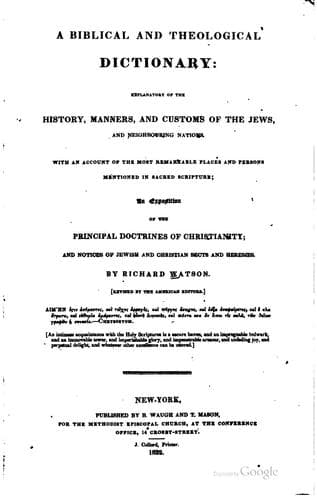
A Biblical and Theological Dictionary: explanatory of the history, manners, and customs of the Jews, and neighbouring nationsWatson, Richard
Religion
A Biblical and Theological Dictionary: explanatory of the history, manners, and customs of the Jews, and neighbouring nations
Watson, Richard
Bible -- Dictionaries; Theology -- Dictionaries
can make it: but though we allow a spiritual principle to animals, its
_kind_ is obviously inferior; for that spirit which is incapable of
induction and moral knowledge, must be of an inferior order to the
spirit which possesses these capabilities; and this is the kind of
spirit which is peculiar to man.
The sentiment expressed in Wisdom ii, 23, is an evidence that, in the
opinion of the ancient Jews, the image of God in man comprised
_immortality_ also. “For God created man to be immortal, and made him to
be an image of his own eternity:” and though other creatures were made
capable of immortality, and at least the material human frame, whatever
we may think of the case of animals, would have escaped death, had not
sin entered the world; yet, without admitting the absurdity of the
“natural immortality” of the human soul, that essence must have been
constituted immortal in a high and peculiar sense which has ever
retained its prerogative of continued duration amidst the universal
death not only of animals, but of the bodies of all human beings. There
appears also a manifest allusion to man’s immortality, as being included
in _the image of God_, in the reason which is given in Genesis for the
law which inflicts death on murderers: “Whoso sheddeth man’s blood, by
man shall his blood be shed: for in _the image of God_ made he man.” The
essence of the crime of homicide is not confined here to the putting to
death the mere animal part of man; and it must, therefore, lie in the
peculiar value of life to an immortal being, accountable in another
state for the actions done in this, and whose life ought to be specially
guarded for this very reason, that death introduces him into changeless
and eternal relations, which were not to be left to the mercy of human
passions.
To these we are to add the _intellectual powers_, and we have what
divines, in perfect accordance with the Scriptures, have called, “the
NATURAL image of God in his creatures,” which is essential and
ineffaceable. Man was made capable of _knowledge_, and he was endowed
with liberty of _will_.
Public-domain text, read in full here on John Shaqi.
Reviews
Reviews
No reviews yet
Be the first to share your thoughts on this work.
Join the Discussion
Join the discussion
Sign in to leave a comment or review.
Sign InorCreate an account