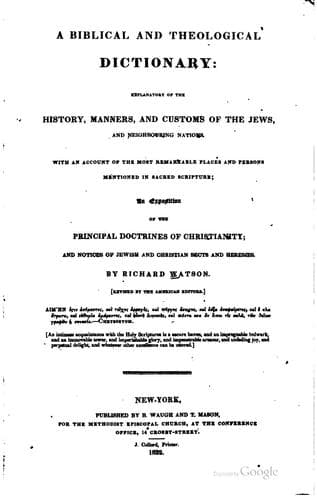
A Biblical and Theological Dictionary: explanatory of the history, manners, and customs of the Jews, and neighbouring nationsWatson, Richard
Religion
A Biblical and Theological Dictionary: explanatory of the history, manners, and customs of the Jews, and neighbouring nations
Watson, Richard
Bible -- Dictionaries; Theology -- Dictionaries
The “image” or likeness of God in which man was made has, by some, been
assigned to the body; by others, to the soul. It has, also, been placed
in the circumstance of his having “_dominion_” over the other creatures.
As to the body, it is not necessary to prove that in no sense can it
bear the image of God; that is, be “_like_” God. An upright form has no
more likeness to God than a prone or reptile one; God is incorporeal,
and cannot be the antitype of any thing material.
Equally unfounded is the notion that the image of God in man consisted
in the “dominion” which was granted to him over this lower world.
Limited dominion may, it is true, be an image of large and absolute
dominion; but man is not said to have been made in the image of God’s
dominion, which is an accident merely, for, before creatures existed,
God himself could have no dominion:--he was made in the image and
likeness of God himself. Still farther, it is evident that man,
according to the history, was made in the image of God _in order_ to his
having dominion, as the Hebrew particle imports; and, therefore, his
dominion was consequent upon his formation in the “image” and “likeness”
of God, and could not be that image itself.
The notion that the original resemblance of man to God must be placed in
some one essential quality, is not consistent with holy writ, from which
alone we can derive our information on this subject. We shall, it is
true, find that the Bible partly places it in what is essential to human
nature; but that it should comprehend nothing else, or consist in one
quality only, has no proof or reason; and we are, in fact, taught that
it comprises also what is so far from being essential that it may be
both lost and regained. When God is called “the Father of spirits,” a
likeness is suggested between man and God in the _spirituality_ of their
nature. This is also implied in the striking argument of St. Paul with
the Athenians: “Forasmuch, then, as we are the OFFSPRING of God, we
ought not to think that the Godhead is like unto gold, or silver, or
stone, graven by art and man’s device;”--plainly referring to the
idolatrous statues by which God was represented among Heathens. If
likeness to God in man consisted in bodily shape, this would not have
been an argument against human representations of the Deity; but it
imports, as Howe well expresses it, that “we are to understand that our
resemblance to him, as we are his offspring, lies in some higher, more
noble, and more excellent thing, of which there can be no figure; as who
can tell how to give the figure or image of a thought, or of the mind or
thinking power?” In _spirituality_, and, consequently, immateriality,
this image of God in man, then, in the first instance, consists. Nor is
it any valid objection to say, that “immateriality is not peculiar to
the soul of man; for we have reason to believe that the inferior animals
are actuated by an immaterial principle.” This is as certain as analogy
Public-domain text, read in full here on John Shaqi.
Reviews
Reviews
No reviews yet
Be the first to share your thoughts on this work.
Join the Discussion
Join the discussion
Sign in to leave a comment or review.
Sign InorCreate an account