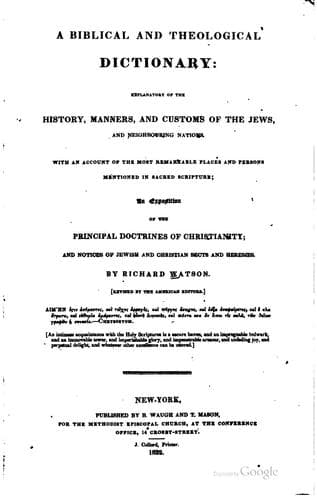
A Biblical and Theological Dictionary: explanatory of the history, manners, and customs of the Jews, and neighbouring nations — John Shaqi
A Biblical and Theological Dictionary: explanatory of the history, manners, and customs of the Jews, and neighbouring nationsWatson, Richard
Religion
A Biblical and Theological Dictionary: explanatory of the history, manners, and customs of the Jews, and neighbouring nations
Watson, Richard
Bible -- Dictionaries; Theology -- Dictionaries
This natural image of God was the foundation of that MORAL image by
which also man was distinguished. Unless he had been a spiritual,
knowing, and willing being, he would have been wholly incapable of
_moral_ qualities. That he had such qualities eminently, and that in
them consisted the image of God, as well as in the natural attributes
just stated, we have also the express testimony of Scripture: “Lo this
only have I found, that God made man UPRIGHT; but they have sought out
many inventions.” There is also an express allusion to the moral image
of God, in which man was at first created, in Colossians iii, 10: “And
have put on the new man, which is renewed in knowledge, after the image
of Him that created him;” and in Ephesians iv, 24: “Put on the new man,
which after God is created in righteousness and true holiness.” In these
passages the Apostle represents the change produced in true Christians
by the Gospel, as a “renewal of the image of God in man; as a new or
second creation in that image;” and he explicitly declares, that that
image consists in “knowledge,” in “righteousness,” and in “true
holiness.”
This also may be finally argued from the satisfaction with which the
historian of the creation represents the Creator as viewing the works of
his hands as “_very good_,” which was pronounced with reference to each
of them individually, as well as to the whole: “And God saw _every
thing_ that he had made, and behold it was very good.” But, as to man,
this goodness must necessarily imply moral as well as physical
qualities. Without them he would have been imperfect as _man_; and had
they, in their first exercises, been perverted and sinful, he must have
been an exception, and could not have been pronounced “very good.” The
goodness of man, as a rational being, must lie in devotedness and
consecration to God; consequently, man was at first holy. A rational
creature, as such, is capable of knowing, loving, serving, and living in
communion with the Most Holy One. Adam, at first, did or did not exert
this capacity; if he did not, he was not _very good_,--not good at all.
4. On the intellectual and moral endowments of the progenitor of the
human race, erring views appear to have been taken on both sides.
In knowledge, some have thought him little inferior to the angels;
others, as furnished with but the simple elements of science and of
language. The truth seems to be that, as to _capacity_, his intellect
must have been vigorous beyond that of any of his fallen descendants;
which itself gives us very high views of the strength of his
understanding, although we should allow him to have been created “lower
than the angels.” As to his _actual knowledge_, that would depend upon
the time and opportunity he had for observing the nature and laws of the
objects around him; and the degree in which he was favoured with
revelations from God on moral and religious subjects.
Public-domain text, read in full here on John Shaqi.
Reviews
Reviews
No reviews yet
Be the first to share your thoughts on this work.
Join the Discussion
Join the discussion
Sign in to leave a comment or review.
Sign InorCreate an account