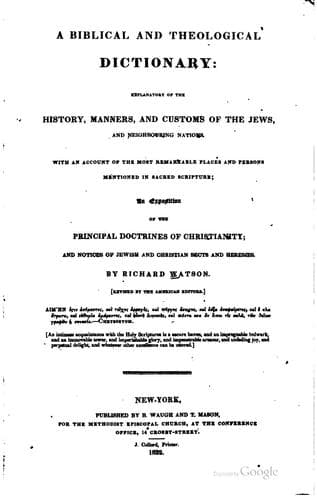
A Biblical and Theological Dictionary: explanatory of the history, manners, and customs of the Jews, and neighbouring nationsWatson, Richard
Religion
A Biblical and Theological Dictionary: explanatory of the history, manners, and customs of the Jews, and neighbouring nations
Watson, Richard
Bible -- Dictionaries; Theology -- Dictionaries
ADOPTION. An act by which one takes another into his family, owns him
for his son, and appoints him his heir. The Greeks and Romans had many
regulations concerning adoption. It does not appear that adoption,
properly so called, was formerly in use among the Jews. Moses makes no
mention of it in his laws; and the case of Jacob’s two grandsons, Gen.
xlviii, 14, seems rather a substitution.
2. Adoption in a theological sense is that act of God’s free grace by
which, upon our being justified by faith in Christ, we are received into
the family of God, and entitled to the inheritance of heaven. This
appears not so much a distinct act of God, as involved in, and
necessarily flowing from, our justification; so that, at least the one
always implies the other. Nor is there any good ground to suppose that
in the New Testament the term adoption is used with any reference to the
civil practice of adoption by the Greeks, Romans, or other Heathens, and
therefore it is not judicious to illustrate the texts in which the word
occurs by their formalities. The Apostles in using the term appear to
have had before them the simple view, that our sins had deprived us of
our sonship, the favour of God, and the right to the inheritance of
eternal life; but that, upon our return to God, and reconciliation with
him, our forfeited privileges were not only restored, but greatly
heightened through the paternal kindness of God. They could scarcely be
forgetful of the affecting parable of the prodigal son; and it is under
the same view that St. Paul quotes from the Old Testament, “Wherefore
come out from among them, and be ye separate, saith the Lord, and touch
not the unclean thing, and I will receive you, and I will be a Father
unto you, and ye shall be my sons and daughters, saith the Lord
Almighty.”
Adoption, then, is that act by which we who were alienated, and enemies,
and disinherited, are made the sons of God, and heirs of his eternal
glory. “If children, then heirs, heirs of God and joint heirs with
Christ;” where it is to be remarked, that it is not in our own right,
nor in the right of any work done in us, or which we ourselves do,
though it should be an evangelical work, that we become heirs; but
jointly with Christ, and in his right.
3. To this state belong, freedom from a servile spirit, for we are not
servants but sons; the special love and care of God our heavenly Father;
a filial confidence in him; free access to him at all times and in all
circumstances; a title to the heavenly inheritance; and the Spirit of
adoption, or the witness of the Holy Spirit to our adoption, which is
the foundation of all the comfort we can derive from those privileges,
as it is the only means by which we can know that they are ours.
Public-domain text, read in full here on John Shaqi.
Reviews
Reviews
No reviews yet
Be the first to share your thoughts on this work.
Elsewhere in the archive
Join the Discussion
Join the discussion
Sign in to leave a comment or review.
Sign InorCreate an account