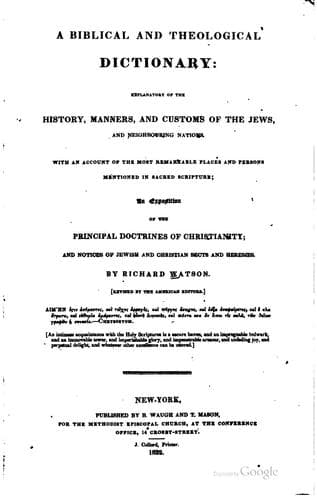
A Biblical and Theological Dictionary: explanatory of the history, manners, and customs of the Jews, and neighbouring nationsWatson, Richard
Religion
A Biblical and Theological Dictionary: explanatory of the history, manners, and customs of the Jews, and neighbouring nations
Watson, Richard
Bible -- Dictionaries; Theology -- Dictionaries
4. The last mentioned great privilege of adoption merits special
attention. It consists in the inward witness or testimony of the Holy
Spirit to the sonship of believers, from which flows a comfortable
persuasion or conviction of our present acceptance with God, and the
hope of our future and eternal glory. This is taught in several passages
of Scripture:--
Rom. viii, 15, 16, “For ye have not received the spirit of bondage again
to fear, but the Spirit of adoption, whereby we cry, Abba, Father. The
Spirit itself beareth witness with our spirit that we are the children
of God.” In this passage it is to be remarked, 1. That the Holy Spirit
takes away “fear,” a servile dread of God as offended. 2. That the
“Spirit of God” here mentioned, is not the personified spirit or genius
of the Gospel, as some would have it, but “the Spirit itself,” or
himself, and hence he is called in the Galatians, “the Spirit of his
Son,” which cannot mean the genius of the Gospel. 3. That he inspires a
filial confidence in God, as our Father, which is opposed to “the fear”
produced by the “spirit of bondage.” 4. That he excites this filial
confidence, and enables us to call God our Father, by witnessing,
bearing testimony with our spirit, “that we are the children of God.”
Gal. iv, 4–6, “But when the fulness of the time was come, God sent forth
his Son, made of a woman, made under the law, to redeem them that were
under the law, that we might receive the adoption of sons; and because
ye are sons, God hath sent forth the Spirit of his Son into your hearts,
crying, Abba, Father.” Here also are to be noted, 1. The means of our
redemption from under (the curse of) the law,--the incarnation and
sufferings of Christ. 2. That the adoption of sons follows upon our
actual redemption from that curse, or, in other words, upon our pardon.
3. That upon our being pardoned, the “Spirit of the Son” is “sent forth
into our hearts,” producing the same effect as that mentioned in the
Epistle to the Romans, viz. filial confidence in God,--“crying, Abba,
Father.” To these texts are to be added all those passages, so numerous
in the New Testament, which express the confidence and the joy of
Christians; their friendship with God; their confident access to him as
their God; their entire union and delightful intercourse with him in
spirit.
This has been generally termed the doctrine of assurance, and, perhaps,
the expressions of St. Paul, “the full assurance of faith,” and “the
full assurance of hope,” may warrant the use of the word. But as there
is a current and generally understood sense of this term, implying that
the assurance of our present acceptance and sonship implies an assurance
of our final perseverance, and of an indefeasible title to heaven; the
phrase, a comfortable persuasion, or conviction of our justification and
adoption, arising out of the Spirit’s inward and direct testimony, is to
be preferred.
Public-domain text, read in full here on John Shaqi.
Reviews
Reviews
No reviews yet
Be the first to share your thoughts on this work.
Elsewhere in the archive
Join the Discussion
Join the discussion
Sign in to leave a comment or review.
Sign InorCreate an account