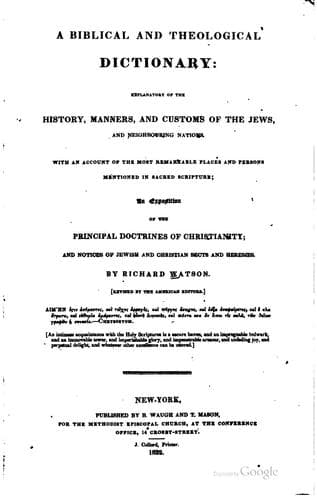
A Biblical and Theological Dictionary: explanatory of the history, manners, and customs of the Jews, and neighbouring nationsWatson, Richard
Religion
A Biblical and Theological Dictionary: explanatory of the history, manners, and customs of the Jews, and neighbouring nations
Watson, Richard
Bible -- Dictionaries; Theology -- Dictionaries
There is, also, another reason for the sparing and cautious use of the
term assurance, which is, that it seems to imply, though not
necessarily, the absence of all doubt, and shuts out all those lower
degrees of persuasion which may exist in the experience of Christians.
For, our faith may not at first, or at all times, be equally strong, and
the testimony of the Spirit may have its degrees of clearness.
Nevertheless, the fulness of this attainment is to be pressed upon every
one: “Let us draw near,” says St. Paul to all Christians, “with full
assurance of faith.”
It may serve, also, to remove an objection sometimes made to the
doctrine, and to correct an error which sometimes pervades the statement
of it, to observe that this assurance, persuasion, or conviction,
whichever term be adopted, is not of the essence of justifying faith;
that is, justifying faith does not consist in the assurance that I am
now forgiven, through Christ. This would be obviously contradictory. For
we must believe before we can be justified; much more before we can be
assured, in any degree, that we are justified:--this persuasion,
therefore, follows justification, and is one of its results. But though
we must not only distinguish, but separate, this persuasion of our
acceptance from the faith which justifies, we must not separate it, but
only distinguish it, from justification itself. With that come in as
concomitants, adoption, the “Spirit of adoption,” and regeneration.
ADORATION, the act of rendering divine honours; or of addressing God or
any other being as supposing it to be God. (See _Worship_.) The word is
compounded of _ad_, “to,” and _os_, “mouth;” and literally signifies to
apply the hand to the mouth; _manum ad os admovere_, “to kiss the hand;”
this being in eastern countries one of the great marks of respect and
submission. To this mode of idolatrous worship Job refers, xxxi, 26, 27.
See also 1 Kings xix, 18.
The Jewish manner of adoration was by prostration, bowing, and kneeling.
The Christians adopted the Grecian, rather than the Roman, method, and
always adored uncovered. The ordinary posture of the ancient Christians
was kneeling; but on Sundays, standing.
ADORATION is also used for certain extraordinary acts of civil honour,
which resemble those paid to the Deity, yet are given to men.
We read of adorations paid to kings, princes, emperors, popes, bishops,
abbots, &c, by kneeling, falling prostrate, kissing the feet, hands,
garments, &c.
Public-domain text, read in full here on John Shaqi.
Reviews
Reviews
No reviews yet
Be the first to share your thoughts on this work.
Elsewhere in the archive
Join the Discussion
Join the discussion
Sign in to leave a comment or review.
Sign InorCreate an account