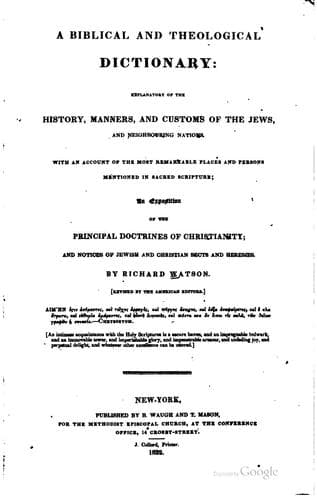
A Biblical and Theological Dictionary: explanatory of the history, manners, and customs of the Jews, and neighbouring nationsWatson, Richard
Religion
A Biblical and Theological Dictionary: explanatory of the history, manners, and customs of the Jews, and neighbouring nations
Watson, Richard
Bible -- Dictionaries; Theology -- Dictionaries
AERIANS, a sect which arose about the middle of the fourth century,
being the followers of Aërius, (who must be distinguished from Arius and
Aëtius,) a monk and a presbyter of Sebastia, in Pontus. He is charged
with being an Arian, or Semi-Arian; but the heaviest accusation against
him is an attempt to reform the church; and, by rejecting prayers for
the dead, with certain fasts and festivals then superstitiously
observed, to reduce Christianity as nearly as possible “to its primitive
simplicity; a purpose, indeed, laudable and noble,” says Dr. Mosheim,
“when considered in itself: though the principles from _whence_ it
springs, and the means _by_ which it is executed, are sometimes, in many
respects, worthy of censure, and _may_ have been so in the case of this
reformer.” This gentle rebuke probably refers to a report that the zeal
of Aërius originated in his being disappointed of the bishopric of
Sebastia, (conferred on Eustathius,) which led him to affirm that the
Scriptures make no distinction between a presbyter and a bishop, which
he founded chiefly on 1 Tim. iv, 14. Hence he is considered by many, as
the father of the modern Presbyterians.--“For this opinion, _chiefly_,”
says Dr. Turner, “he is ranked among the heretics, by Epiphanius, his
contemporary, who calls it a notion _full of folly and madness_. His
followers were driven from the churches, and out of all the towns and
villages, and were obliged to assemble in the woods, caverns, and open
defiles.”
AETIANS, another branch (as it is said) of Arians, so called from
Aëtius, bishop of Antioch, who is also charged with maintaining “faith
without works,” as “sufficient to salvation,” or rather justification;
and with maintaining “that sin is not imputed to believers.” It is
added, that he taught God had revealed to him things which he had
“concealed from the Apostles;” which, perhaps, is only a
misrepresentation of what he taught on the doctrine of divine
influences.
Public-domain text, read in full here on John Shaqi.
Reviews
Reviews
No reviews yet
Be the first to share your thoughts on this work.
Elsewhere in the archive
Join the Discussion
Join the discussion
Sign in to leave a comment or review.
Sign InorCreate an account