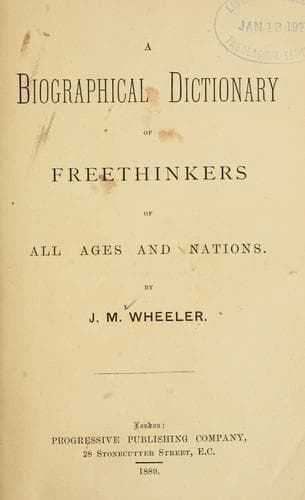
A Biographical Dictionary of Freethinkers of All Ages and NationsWheeler, J. M. (Joseph Mazzini)
Religion
A Biographical Dictionary of Freethinkers of All Ages and Nations
Wheeler, J. M. (Joseph Mazzini)
Free thought -- Biography
Epicurus, Greek philosopher, b. Samos, B.C. 342. He repaired to
Athens, B.C. 323. Influenced by the works of Demokritos, he occupied
himself with philosophy. He purchased a garden in Athens, in which he
established his school. Although much calumniated, he is now admitted
to have been a man of blameless life. According to Cicero, he had no
belief in the gods, but did not attack their existence, in order not
to offend the prejudices of the Athenians. In physics he adopted the
atomic theory, and denied immortality. He taught that pleasure is the
sovereign good; but by pleasure he meant no transient sensation, but
permanent tranquility of mind. He wrote largely, but his works are
lost. His principles are expounded in the great poem of Lucretius,
De Rerum Natura. Died B.C. 270, leaving many followers.
"Erdan (Alexandre)," the pen-name of Alexandre Andre Jacob, a French
writer, b. Angles 1826. He was the natural son of a distinguished
prelate. Educated at Saint Sulpice for the Church, he read Proudhon,
and refused to take holy orders. He became a journalist and an advocate
of phonography. His work, La France Mystique (1855), in which he
gives an account of French religious eccentricities, was condemned
for its scepticism which appears on every page. Sentenced to a year's
imprisonment and a fine of three thousand francs, he took refuge in
Italy. Died at Frascati, near Rome, 24 Sept. 1878.
Ernesti (Johann August), German critic, b. Tennstadt, 4
Aug. 1707. Studied at Wittenberg and Leipsic, where he was appointed
professor of classical literature. Renowned as a philologist, he
insisted that the Bible must be interpreted like any other book. Died
Leipsic, 11 Sept. 1781.
Escherny (François Louis d') Count, Swiss litterateur, b. Neufchatel,
24 Nov. 1733. He spent much of his life in travel. At Paris he became
the associate of Helvetius, Diderot, and particularly Rousseau, whom he
much admired. He wrote Lacunes de la Philosophie (Amsterdam, 1783) and
a work on Equality (1795), in which he displays his Freethought. Died
at Paris, 15 July, 1815.
Espinas (Alfred), French philosopher, b. Saint-Florentin, 1844. Has
translated, with Th. Ribot, H. Spencer's Principles of Psychology,
and has written studies on Experimental Philosophy in Italy, and on
Animal Societies (1877).
Public-domain text, read in full here on John Shaqi.
Reviews
Reviews
No reviews yet
Be the first to share your thoughts on this work.
Elsewhere in the archive
Join the Discussion
Join the discussion
Sign in to leave a comment or review.
Sign InorCreate an account