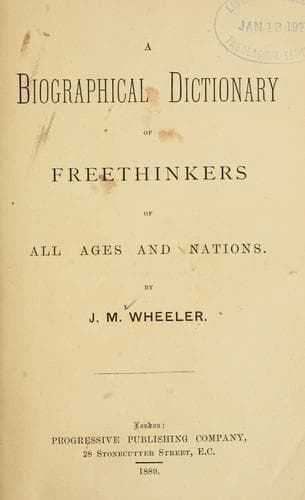
A Biographical Dictionary of Freethinkers of All Ages and NationsWheeler, J. M. (Joseph Mazzini)
Religion
A Biographical Dictionary of Freethinkers of All Ages and Nations
Wheeler, J. M. (Joseph Mazzini)
Free thought -- Biography
Feuerbach (Ludwig Andreas), brother of the preceding, b. Landshut,
Bavaria, 28 July 1804. He studied theology with a view to the Church,
but under the influence of Hegel abandoned it for philosophy. In '28
he was made professor at Erlangen, but was dismissed in consequence
of his first published work, Thoughts upon Death and Immortality,
'30, in which he limited immortality to personal influence on the
human race. After a wandering life he married in '37, and settled
near Anspach. He published there a history of modern philosophy from
Bacon to Spinoza. This was followed by a work on Peter Bayle. In '38
he wrote on philosophy and Christianity, and in '41 his work called
the The Essence of Christianity, in which he resolves theology
into anthropology. This book was translated by Mary Ann Evans,
'53. He also wrote Principles of the Philosophy of the Future. After
the revolution of '48 he was invited to lecture by the students of
Heidelberg, and gave his course on The Essence of Religion, published
in '51. In '57 he published Theogony from the Sources of Classical,
Hebrew, and Christian Antiquity, and in '66 Theism, Freedom, and
Immortality from the Standpoint of Anthropology. Died at Rechenberg,
near Nurenberg, 13 Sept. 1872. His complete works were published at
Leipsic in 1876. He was a deep thinker and lucid writer.
Fichte (Johann Gottlieb), one of the greatest German thinkers,
b. 19 May, 1762. He studied at the Universities of Jena, Leipsic,
and Wittenberg, embraced "determinism," became acquainted with Kant,
and published anonymously, A Criticism of all Revelation. He obtained
a chair of philosophy at Jena, where he developed his doctrines
of science, asserting that the problem of philosophy is to seek
on what foundations knowledge rests. He gave moral discourses in
the lecture-room on Sunday, and was accused of holding atheistical
opinions. He was in consequence banished from Saxony, 1799. He appears
to have held that God was not a personal being, but a system of
intellectual, moral, and spiritual laws. Fichte took deep interest in
the cause of German independence, and did much to rouse his countrymen
against the domination of the French during the conquest which led to
the fall of Napoleon. Besides many publications, in which he expounds
his philosophy, he wrote eloquent treatises on The Vocation of Man,
The Nature and Vocation of the Scholar, The Way Towards the Blessed
Life, etc. Died Berlin 27 Jan. 1814.
"Figaro." See Larra (Mariano José de).
Figuiera (Guillem), Provençal troubadour and precursor of the
Renaissance, b. Toulouse about 1190. His poems were directed against
the priests and Court of Rome.
Filangieri (Gaetano), an Italian writer on legislation, b. Naples,
18 Aug. 1752. He was professor at that city. His principal work is
La Scienza della Legislazione, 1780. In the fifth volume he deals
with pre-Christian religions. The work was put on the Index. Died 21
July, 1788.
Public-domain text, read in full here on John Shaqi.
Reviews
Reviews
No reviews yet
Be the first to share your thoughts on this work.
Elsewhere in the archive
Join the Discussion
Join the discussion
Sign in to leave a comment or review.
Sign InorCreate an account