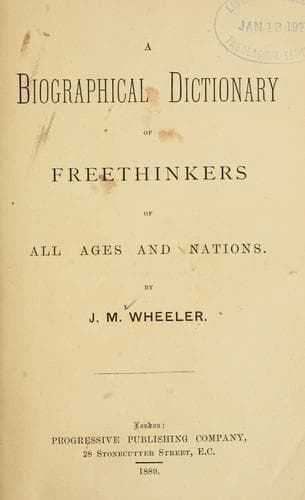
A Biographical Dictionary of Freethinkers of All Ages and NationsWheeler, J. M. (Joseph Mazzini)
Religion
A Biographical Dictionary of Freethinkers of All Ages and Nations
Wheeler, J. M. (Joseph Mazzini)
Free thought -- Biography
Flourens (Marie Jean Pierre), French scientist, b. near Béziers, 15
April, 1794. In 1828 he was admitted into the Academy of Sciences,
after having published a work on the nervous system of vertebrates;
he became perpetual secretary in '33. A work on Human Longevity and
the Quantity of Life on the Globe was very popular. Died near Paris,
6 Dec. 1867.
Flourens (Gustave), eldest son of the preceding, b. Paris,
4 Aug. 1838. In '63 he took his father's chair at the College of
France, and his course on "Ethnography" attracted much attention. In
the following year he published his work on The Science of Man. His
bold heresy lost him his chair, and he collaborated on Larousse's
Grand Dictionnaire. In '65 he left France for Crete, where for three
years he fought in the mountains against the Turkish troops. Upon
his return he was arrested for presiding at a political meeting. He
showed himself an ardent Revolutionist, and was killed in a skirmish
near Nanterre, 3 April, 1871.
Fonblanque (Albany William), English journalist, b. London, 1793;
the son of an eminent lawyer. In 1820 he was on the staff of the
Times, and contributed to the Westminster Review. In '30 he became
editor of the Examiner, and retained his post until '47. His caustic
wit and literary attainments did much to forward advanced liberal
views. A selection of his editorials was published under the title,
England under Seven Administrations. Died 13 Oct. 1872.
Fontanier (Jean), French writer, who was burnt at the Place
de Grève, 1621, for blasphemies in a book entitled Le Tresor
Inestimable. Garasse, with little reason, calls him an Atheist.
Fontenelle (Bernard le Bovier de), nephew of Corneille, called
by Voltaire the most universal genius of the reign of Louis XIV.,
b. Rouen, 11 Feb. 1657. Dedicated to the Virgin and St. Bernard,
he was educated at the Jesuits' College. He went to Paris in 1674;
wrote some plays and Dialogues of the Dead, 1683. In 1686 appeared
his Conversations on the Plurality of Worlds, and in the following
year his History of Oracles, based on the work of Van Dale, for which
he was warmly attacked by the Jesuit Baltus, as impugning the Church
Fathers. He was made secretary to the Academy of Sciences in 1699,
a post he held forty-two years. He wrote Doubts on the Physical
System of Occasional Causes, and is also credited with a letter
on the Resurrection of the Body, a piece on The Infinite, and a
Treatise on Liberty; "but," says l'Abbé Ladvocat, "as these books
contain many things contrary to religion, it is to be hoped they are
not his." Fontenelle nearly reached the age of one hundred. A short
time before he died (9 Jan. 1757), being asked if he felt any pain,
"I only feel," he replied, "a difficulty of existing."
Public-domain text, read in full here on John Shaqi.
Reviews
Reviews
No reviews yet
Be the first to share your thoughts on this work.
Elsewhere in the archive
Join the Discussion
Join the discussion
Sign in to leave a comment or review.
Sign InorCreate an account