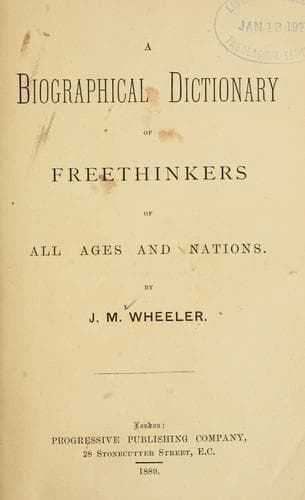
A Biographical Dictionary of Freethinkers of All Ages and NationsWheeler, J. M. (Joseph Mazzini)
Religion
A Biographical Dictionary of Freethinkers of All Ages and Nations
Wheeler, J. M. (Joseph Mazzini)
Free thought -- Biography
Guadet (Marguerite Elie), Girondin, b. Saint Emilion (Gironde),
20 July, 1758. He studied at Bordeaux, and became an advocate in
'81. He threw himself enthusiastically into the Revolution, and was
elected Deputy for the Gironde. His vehement attacks on the Jacobins
contributed to the destruction of his party, after which he took
refuge, but was arrested and beheaded at Bordeaux, 15 June, 1794.
Gubernatis (Angelo de), see De Gubernatis.
Guépin (Ange), French physician, b. Pontivy, 30 Aug. 1805. He became
M.D. in '28. After the revolution of July, '30, Dr. Guépin was made
Professor at the School of Medicine at Nantes. He formed the first
scientific and philosophical congress, held there in '33. In '48 he
became Commissaire of the Republic at Nantes, and in '50 was deprived
of his situation. In '54 he published his Philosophy of the Nineteenth
Century. After the fall of the Empire, M. Guépin became Prefet of La
Loire Inférieure, but had to resign from ill-health. Died at Nantes,
21 May, 1873, and was buried without any religious ceremony.
Gueroult (Adolphe), French author, b. Radepont (Eure), 29
Jan. 1810. Early in life he became a follower of Saint Simon. He wrote
to the Journal des Debats, the Republique, Credit and Industrie, and
founded l'Opinion National. He was elected to the Legislature in '63,
when he advocated the separation of Church and State. Died at Vichy,
21 July, 1872.
Guerra Junqueiro. Portuguese poet, b. 1850. His principal work is a
poem on The Death of Don Juan, but he has also written The Death of
Jehovah, an assault upon the Catholic faith from the standpoint of
Pantheism. Portuguese critics speak highly of his powers.
Guerrini (Olindo), Italian poet, b. Forli, 4 Oct. 1845. Educated
at Ravenna, Turin, and Bologna University; he has written many fine
poems under the name of Lorenzo Stecchetti. In the preface to Nova
Polemica he declares "Primo di tutto dice, non credo in Dio" ("First
of all I say do not believe in God.")
Gueudeville (Nicolas), French writer, b. Rouen, 1654. He became a
Benedictine monk, and was distinguished as a preacher, but the boldness
of his opinions drew on him the punishment of his superiors. He escaped
to Holland, and publicly abjured Catholicism. He taught literature
and philosophy at Rotterdam, wrote the Dialogue of the Baron de la
Hontan with an American Savage Amst. 1704, appended to the Travels
of La Hontan, 1724, edited by Gueudeville. This dialogue is a bitter
criticism of Christian usages. He translated Erasmus's Praise of Folly
(1713), More's Utopia (1715), and C. Agrippa, Of the Uncertainty and
Vanity of Sciences (1726). Died at the Hague, 1720.
Guichard (Victor), French writer, b. Paris, 15 Aug. 1803. He became
Mayor of Sens, and was elected deputy for the Yonne department. He
was exiled in '52, but again elected in '71. His principal work is
La Liberté de Penser, fin du Pouvoir Spirituel (1868). Died at Paris,
11th Nov. 1884.
Public-domain text, read in full here on John Shaqi.
Reviews
Reviews
No reviews yet
Be the first to share your thoughts on this work.
Elsewhere in the archive
Join the Discussion
Join the discussion
Sign in to leave a comment or review.
Sign InorCreate an account