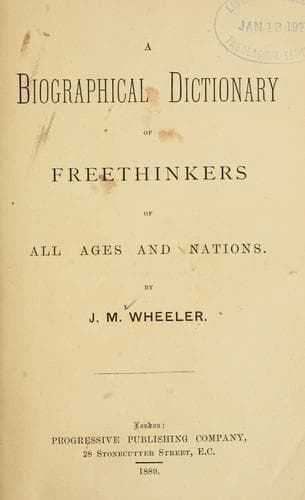
A Biographical Dictionary of Freethinkers of All Ages and NationsWheeler, J. M. (Joseph Mazzini)
Religion
A Biographical Dictionary of Freethinkers of All Ages and Nations
Wheeler, J. M. (Joseph Mazzini)
Free thought -- Biography
Kant (Immanuel), German critical philosopher, b. Königsberg, 22
April, 1724. He became professor of mathematics in 1770. In 1781 he
published his great work, The Critick of Pure Reason, which denied
all knowledge of the "Thing itself," and overthrew the dogmatism of
earlier metaphysics. In 1792 the philosopher fell under the royal
censorship for his Religion within the Limits of Pure Reason. Kant
effected a complete revolution in philosophy, and his immediate
influence is not yet exhausted. Died at Königsberg, 12 Feb. 1804.
Kapila. One of the earliest Hindu thinkers. His system is known as
the Atheistic philosophy. It is expounded in the Sankhya Karika, an
important relic of bold rationalistic Indian thought. His aphorisms
have been translated by J. R. Ballantyne.
Karneades. See Carneades.
Keeler (Bronson C.) American author of an able Short History of the
Bible, being a popular account of the formation and development of
the canon, published at Chicago 1881.
Keim (Karl Theodor), German rationalist, b. Stuttgart,
17 Dec. 1825. Was educated at Tübingen, and became professor of
theology at Zürich. Is chiefly known by his History of Jesus of Nazara
('67-'72). He also wrote a striking work on Primitive Christianity
('78), and endeavored to reproduce the lost work of Celsus. His
rationalism hindered his promotion, and he was an invalid most of
his days. Died at Giessen, where he was professor, 17 Nov. 1878.
Keith (George), Lord Marshall, Scotch soldier, b. Kincardine 1685,
was appointed by Queen Anne captain of Guard. His property being
confiscated for aiding the Pretender, he went to the Continent, and
like his brother, was in high favor with Frederick the Great. Died
Berlin, 25 May, 1778.
Keith (James Francis Edward), eminent military commander, b. Inverugie,
Scotland, 11 June, 1696. Joined the army of the Pretender and was
wounded at Sheriffmuir, 1715. He afterwards served with distinction
in Spain and in Russia, where he rose to high favor under the
Empress Elizabeth. In 1747 he took service with Frederick the Great
as field-marshal, and became Governor of Berlin. Carlyle calls him
"a very clear-eyed, sound observer of men and things. Frederick, the
more he knows him, likes him the better." From their correspondence
it is evident Keith shared the sceptical opinions of Frederick. After
brilliant exploits in the seven years' war at Prague, Rossbach, and
Olmutz, Marshal Keith fell in the battle of Hochkirch, 14 Oct. 1758.
Public-domain text, read in full here on John Shaqi.
Reviews
Reviews
No reviews yet
Be the first to share your thoughts on this work.
Elsewhere in the archive
Join the Discussion
Join the discussion
Sign in to leave a comment or review.
Sign InorCreate an account