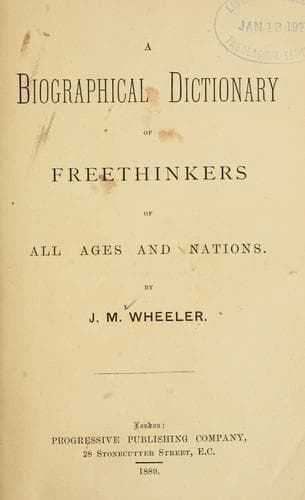
A Biographical Dictionary of Freethinkers of All Ages and NationsWheeler, J. M. (Joseph Mazzini)
Religion
A Biographical Dictionary of Freethinkers of All Ages and Nations
Wheeler, J. M. (Joseph Mazzini)
Free thought -- Biography
Leopardi (Giacomo), count, Italian pessimist poet, b. Recanati
(Ancona), 29 June, 1798. In 1818 he won a high place among poets by
his lines addressed To Italy. His Canti, '31, are distinguished by
eloquence and pathos, while his prose essays, Operette Morali, '27, are
esteemed the finest models of Italian prose of this century. Leopardi's
short life was one long disease, but it was full of work of the
highest character. As a poet, philologist, and philosopher, he is
among the greatest of modern Italians. Died at Naples, 14 July, 1837.
Lequinio (Joseph Marie), French writer and Conventionnel, b. Sarzeau,
1740. Elected Mayor of Rennes, 1790, and Deputy from Morbihar to
the Legislative Assembly. He then professed Atheism. He voted the
death of Louis XVI. "regretting that the safety of the state did not
permit his being condemned to penal servitude for life." In 1792 he
published Prejudices Destroyed, signed "Citizen of the World," in
which he considered religion as a political chain. He took part in the
Feasts of Reason, and wrote Philosophy of the People, 1796. Died 1813.
Lermina (Jules Hippolyte), French writer, b. 27 March, 1839. Founded
the Corsair and Satan, and has published an illustrated biographical
dictionary of contemporary France, 1884-5.
Lermontov (Mikhail Yur'evich), Russian poet and novelist, b. Moscow,
3 Oct. 1814. Said to have come of a Scotch family, he studied at Moscow
University, from which he was expelled. In '32 he entered the Military
Academy at St. Petersburg, and afterwards joined the Hussars. In
'37 some verses on the death of Pushkin occasioned his being sent to
the Caucasus, which he describes in a work translated into English,
'53. His poems are much admired. The Demon, exhibiting Satan in love,
has been translated into English, and so has his romance entitled A
Hero of Our Times. He fell in a duel in the Caucasus, 15 July, 1840.
Leroux (Pierre), French Socialist and philosophic writer, b. Bercy,
near Paris, 6 April, 1797. At first a mason, then a typographer, he
invented an early composing machine which he called the pianotype. In
1824 he became editor of the Globe. Becoming a Saint Simonian,
he made this paper the organ of the sect. He started with Reynaud
L'Encyclopédie Nouvelle, and afterwards with L. Viardot and Mme. George
Sand the Revue Indépendante ('41), which became noted for its pungent
attacks on Catholicism. His principal work is De l'Humanite ('40). In
June '48 M. Leroux was elected to the Assembly. After the coup d'état
he returned to London and Jersey. Died at Paris, 12 April, 1871.
Leroy (Charles Georges), lieutenant ranger of the park of Versailles,
b. 1723, one of the writers on the Encyclopédie. He defended the work
of Helvetius on the Mind against Voltaire, and wrote Philosophical
Letters on the Intelligence and Perfectibility of Animals (1768),
a work translated into English in 1870. Died at Paris 1789.
Public-domain text, read in full here on John Shaqi.
Reviews
Reviews
No reviews yet
Be the first to share your thoughts on this work.
Elsewhere in the archive
Join the Discussion
Join the discussion
Sign in to leave a comment or review.
Sign InorCreate an account