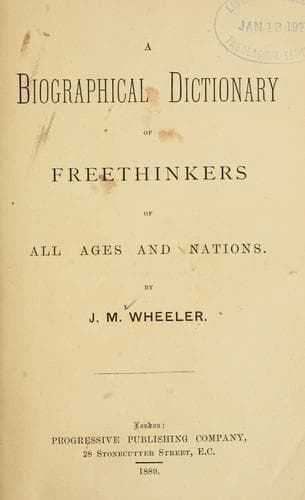
A Biographical Dictionary of Freethinkers of All Ages and NationsWheeler, J. M. (Joseph Mazzini)
Religion
A Biographical Dictionary of Freethinkers of All Ages and Nations
Wheeler, J. M. (Joseph Mazzini)
Free thought -- Biography
Lewes (George Henry), English man of letters, b. in London, 18
April, 1817, he became a journalist and dramatic critic. In 1845-6
appeared his Biographical History of Philosophy, which showed higher
power. This has been republished as History of Philosophy from Thales
to Comte. Lewes was one of the first to introduce English readers to
Comte in his account of Comte's Philosophy of the Sciences, '47. In
'49 he became one of the founders of the Leader, for which he wrote
till '54. In that year he began his association with "George Eliot"
(q.v.). His Life of Goethe appeared in '55, and from this time he
began to give his attention to scientific, especially biological,
studies. In '64 he published an important essay on Aristotle. On
the foundation of the Fortnightly Review, '65, Lewes was appointed
editor. His last work, Problems of Life and Mind, 5 vols. '74-79,
was never completed owing to his death, 28 Nov. 1878. He bequeathed
his books to Dr. Williams's library.
Lichtenberg (Georg Christoph), German satirical writer and scientist,
b. Ober-Ramstädt, 1 July, 1742; a friend of G. Forster, he left many
thoughts showing his advanced opinions. Died Göttingen, 24 Feb. 1799.
Lick (James), American philanthropist, b. Fredericksburg, Pa., 25
Aug. 1796. In 1847 he settled in California and made a large fortune
by investing in real estate. He was a Materialist and bequeathed
large sums to the Lick Observatory, Mount Hamilton, and for other
philanthropic purposes. Died San Francisco, 1 Oct. 1876.
Lilja (Nicolai), Swedish writer, b. Rostanga, 18 Oct. 1808. Studied
at Lund and became parish clerk in the Lund diocese. He wrote, on Man;
his Life and Destiny. Died Lund 1870.
Lincoln (Abraham), sixteenth President of the United States,
b. Kentucky, 12 Feb. 1809. An uncompromising opponent of slavery,
his election (Nov. '60) led to the civil war and the emancipation
of slaves. Ward H. Lamon, who knew him well, says he "read Volney
and Paine and then wrote a deliberate and labored essay, wherein
he reached conclusions similar to theirs. The essay was burnt, but
he never denied or regretted its composition." Mrs. Lincoln said,
"Mr. Lincoln had no hope and no faith in the usual acceptance of those
words." Assassinated 14 April, 1865, he expired the following morning.
Lindet (Robert Thomas), "apostate" French bishop, b. Bernay, 1743. Was
elected to the States-General by the clergy of his district. He
embraced Republican principles, and in March, 1791, was made Bishop
of L'Eure. In Nov. 1792 he publicly married. On 7 Nov. 1793, renounced
his bishopric. He proposed that civil festivals should take the place
of religious ones. He became member of the Conseil des Anciens. Died
Bernay, 10 Aug. 1823, and was buried without religious service.
Public-domain text, read in full here on John Shaqi.
Reviews
Reviews
No reviews yet
Be the first to share your thoughts on this work.
Elsewhere in the archive
Join the Discussion
Join the discussion
Sign in to leave a comment or review.
Sign InorCreate an account