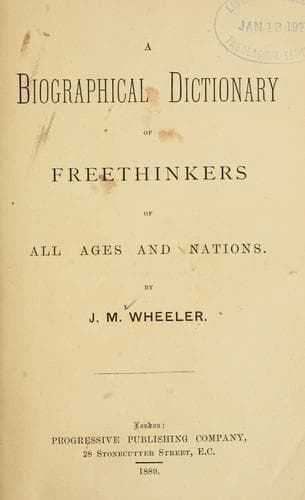
A Biographical Dictionary of Freethinkers of All Ages and NationsWheeler, J. M. (Joseph Mazzini)
Religion
A Biographical Dictionary of Freethinkers of All Ages and Nations
Wheeler, J. M. (Joseph Mazzini)
Free thought -- Biography
Liscow (Christian Ludwig), one of the greatest German satirists,
b. Wittenberg, 29 April, 1701. He studied law in Jena, and became
acquainted with Hagedorn in Hamburg. In 1745 he was Councillor of War
at Dresden. This post he abandoned, occupying himself with literature
until his death, 30 Oct. 1760. Liscow's principal satires are The
Uselessness of Good Works for our Salvation and The Excellence and
Utility of Bad Writers. He has been called the German Swift, and his
works show him to have been an outspoken Freethinker.
Lisle (Lionel), author of The Two Tests: the Supernatural Claims of
Christianity Tried by Two of its own Rules (London, 1877).
Liszinski (Casimir), Polish martyr of noble birth. Denounced as an
Atheist in 1688 by the Bishop of Wilna and Posnovia, he was decapitated
and burnt at Grodno 30 March, 1689. His ashes were placed in a cannon
and scattered abroad. Among the statements in Liszinski's papers was
that man was the creator of God, whom he had formed out of nothing.
Littre (Maximilian Paul Emile), French philologist and philosopher,
b. Paris, 1 Feb. 1801. He studied medicine, literature and most of
the sciences. An advanced Republican, he was one of the editors of
the National. His edition of the works of Hippocrates (1839-61) proved
the thoroughness of his learning. He embraced the doctrines of Comte,
and in '45 published a lucid analysis of the Positive Philosophy. He
translated the Life of Jesus, by Strauss, and wrote the Literary
History of France. His Dictionary of the French Language, in which he
applied the historical method to philology, is one of the most colossal
works ever performed by one man. He wrote on Comte and Positive
Philosophy, Comte and Mill, etc., but refused to follow Comte in his
later vagaries. From '67 till his death he conducted La Philosophie
Positive. Littré also wrote Science from the Standpoint of Philosophy,
'73; Literature and History, '75; Fragments of Positive Philosophy
and Contemporary Sociology, '76. He was proposed for the Academy in
'63, but was bitterly opposed by Bishop Dupanloup, and was elected in
'71. In the same year he was elected to the National Assembly, and in
'75 was chosen senator. Under the Empire he twice refused the Legion
of Honor. After a long life of incessant labor, he died at Paris,
2 June 1881.
Lloyd (John William), American poet and writer, b. of Welsh-English
stock at Westfield, New Jersey, 4 June, 1857. Is mostly
self-educated. After serving apprenticeship as a carpenter, became
assistant to Dr. Trall. Brought up as an orthodox Christian he became
an Agnostic and Anarchist, and has written much in Liberty and Lucifer.
Lohmann (Hartwic), a native of Holstein, who in 1616 occupied a
good position in Flensburg. He was accused of Atheism. In 1635 he
practised medicine at Copenhagen. He wrote a work called the Mirror
of Faith. Died 1642.
Public-domain text, read in full here on John Shaqi.
Reviews
Reviews
No reviews yet
Be the first to share your thoughts on this work.
Elsewhere in the archive
Join the Discussion
Join the discussion
Sign in to leave a comment or review.
Sign InorCreate an account