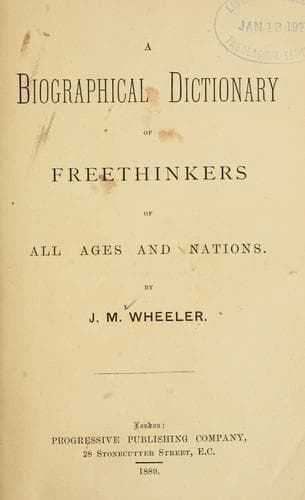
A Biographical Dictionary of Freethinkers of All Ages and NationsWheeler, J. M. (Joseph Mazzini)
Religion
A Biographical Dictionary of Freethinkers of All Ages and Nations
Wheeler, J. M. (Joseph Mazzini)
Free thought -- Biography
Mazzini (Giuseppe), Italian patriot, b. Genoa, 28 June 1808. In '26 he
graduated LL.D., in the University of Genoa, and plunged into politics,
becoming the leader of Young Italy, with the object of uniting the
nation. Condemned to death in '33, he went to Switzerland and was
expelled, then came to England in '37. In '48 he returned, and in March
'49 was made triumvir of Rome with Saffi and Armellini. Compelled,
after a desperate resistance, to retire, he returned to London. He
wrote in the Westminster Review and other periodicals and his works are
numerous though mostly of a political character. They are distinguished
by highmindedness, love of toleration and eloquence. Carlyle called
Mazzini "a man of genius and virtue, a man of sterling veracity,
humanity and nobleness of mind." Died at Pisa 10 March, 1872. He was
a Deist.
Meissner (Alfred), German poet, b. Teplitz, 15 Oct. 1822. Has written
Ziska, an epic poem, The Son of Atta Troll, Recollections of Heine,
etc. Died Teplitz, 20 May, 1885.
Meister (Jacques Henri), Swiss writer, b. Bückeburg, 6
Aug. 1744. Intended for a religious career, he went to France, and
became acquainted with D'Holbach and Diderot, of whom he wrote a short
life, and was secretary to Grimm. He wrote the Origin of Religious
Principles, 1762, and Natural Morality, 1787.
Menard (Louis), French author and painter, b. Paris, 1822. In
'48-'49 he wrote Prologue of a Revolution, for which he was obliged
to leave France. Has written on Morality before the Philosophers,
'60, Studies on the Origin of Christianity, '67, and Freethinkers'
Religious Catechism, '75.
Mendoza (Diego Hurtado de), famous and learned Spanish author, b. of
distinguished family, Granada, 1503. Intended for the church, he
studied Latin, Greek, Arabic, and Hebrew, but on leaving the university
he joined the army. At school he wrote his well known comic novel,
Lazarillo de Tormes, which was condemned by the Inquisition. Sent
on an embassy to Pope Paul III., the latter was greatly shocked at
his audacity and vehemence of speech. His chief work is his History
of the Moorish Wars, which remained unprinted thirty years, through
the intolerant policy of Philip II. Mendoza's satires and burlesques
were also prohibited by the Inquisition. He commented Aristotle and
translated his Mechanics. Died at Valladolid, April, 1575.
Mendum (Josiah P.), publisher and proprietor of the Boston
Investigator, b. Kennebunk, Maine, 7 July, 1811. He became a printer,
and in 1833 became acquainted with Abner Kneeland and after his
imprisonment engaged to print the Investigator, and when Kneeland
left Boston for the West to recruit his health, he carried on the
paper together with Mr. Horace Seaver. Mr. Mendum was one of the
founders of the Paine Memorial Hall, Boston, and a chief support of
Freethought in that city.
Public-domain text, read in full here on John Shaqi.
Reviews
Reviews
No reviews yet
Be the first to share your thoughts on this work.
Elsewhere in the archive
Join the Discussion
Join the discussion
Sign in to leave a comment or review.
Sign InorCreate an account