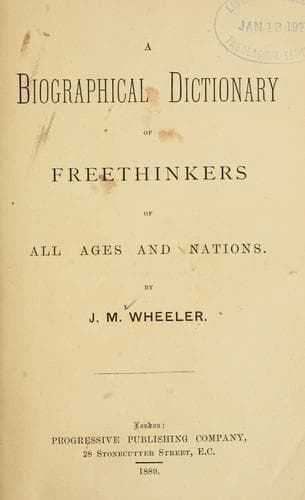
A Biographical Dictionary of Freethinkers of All Ages and NationsWheeler, J. M. (Joseph Mazzini)
Religion
A Biographical Dictionary of Freethinkers of All Ages and Nations
Wheeler, J. M. (Joseph Mazzini)
Free thought -- Biography
Mill (James), philosopher and historian, b. Northwaterbridge, Montrose,
6 April, 1773. Studied at Edinburgh, and distinguished himself by his
attainments in Greek and moral philosophy. He was licensed as preacher
in the Scotch Church, but removed to London in 1800, and became editor
of the Literary Review, and contributed to the reviews. He published,
'17-'19, his History of British India. He contributed many articles to
the fifth edition of the Encyclopædia Britannica. A friend of Bentham,
he wrote largely in the Westminster Review, and did much to forward
the views of Philosophic Radicalism. His Analysis of the Human Mind,
'39, is a profound work. In religion he was a complete sceptic. Reading
Bishop Butler's Analogy made him an Atheist. Died 23 June, 1836.
Mill (John Stuart), eminent English writer, son of the preceding,
b. London, 20 May, 1806. Educated by his father without religion, he
became clerk in the East India House, and early in life contributed to
the Westminster and Edinburgh Reviews. Of the first he became joint
editor in '35. His System of Logic, '43, first made him generally
known. This was followed by his Principles of Political Economy. In
'59 appeared his small but valuable treatise On Liberty, in which he
defends the unrestricted free discussion of religion. Among subsequent
works were Utilitarianism, '63; Auguste Comte and Positivism, '67;
Examination of Sir William Hamilton's Philosophy '65; Dissertations
and Discussions, '59-'75; and the Subjection of Women, '69. In '65
he was elected to Parliament for Westminster, but lost his seat in
'68. In '67 he was chosen Rector of St. Andrews, and delivered the
students an able address. Prof. Bain says "in everything characteristic
of the creed of Christendom he was a thorough-going negationist. He
admitted neither its truth nor its utility." Died at Avignon, 8 May,
1873, leaving behind his interesting Autobiography and three essays on
"Nature," "Theism," and "Religion."
Mille (Constantin), Roumanian writer, b. at Bucharest, educated at
Paris. He lectured at Jassy and Bucharest on the History of Philosophy,
from a Materialistic point of view. He was also active with Codreano,
and after the latter's death ('77), in spreading Socialism. Millé
contributes to the Rivista Sociala and the Vütorul, edited by
C. Pilitis.
Milliere (Jean Baptiste), Socialist, b. of poor parents, Lamarche
(Côte d'Or), 13 Dec. 1817. He became an advocate, and founded the
Proletaire at Clermont Ferrand. For writing Revolutionary Studies he
was, after the coup d'état, banished to Algeria until the amnesty of
'59. In '69 Millière started, with Rochefort, the Marseillaise, of
which he became one of the principal directors. At the election for the
National Assembly he was elected for Paris by 73,000 votes. Although
he took no part in the Commune, but sought to act as an intermediary,
he was arrested and summarily shot near the Pantheon, Paris, 26 May,
1871. He died crying "Vive l'Humanité."
Public-domain text, read in full here on John Shaqi.
Reviews
Reviews
No reviews yet
Be the first to share your thoughts on this work.
Elsewhere in the archive
Join the Discussion
Join the discussion
Sign in to leave a comment or review.
Sign InorCreate an account