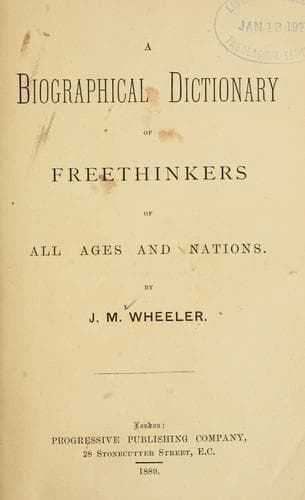
A Biographical Dictionary of Freethinkers of All Ages and NationsWheeler, J. M. (Joseph Mazzini)
Religion
A Biographical Dictionary of Freethinkers of All Ages and Nations
Wheeler, J. M. (Joseph Mazzini)
Free thought -- Biography
Oswald (Felix Leopold), American writer, b. Belgium, 1845. Educated
as a physician, he has devoted his attention to natural history,
and in pursuit of his studies has travelled extensively. He has
contributed to the Popular Science Monthly, The Truthseeker and other
journals, and has published Summerland Sketches, or Rambles in the
Backwoods of Mexico and Central America, '81; Physical Education,
'82; The Secrets of the East, '83, which argues that Christianity
is derived from Buddhism, and The Bible of Nature or the Principles
of Secularism, '88. Dr. Oswald is now employed as Curator of Natural
History in Brazil.
O'Toole (Adam Duff), Irish Freethought martyr, burnt to death at
Hogging (now College) Green, Dublin, in 1327. Holinshed says he
"denied obstinatelie the incarnation of our savior, the trinitie
of persons in the vnitie of the Godhead and the resurrection of the
flesh; as for the Holie Scripture, he said it was but a fable; the
Virgin Marie he affirmed to be a woman of dissolute life, and the
Apostolic see erronious."
"Ouida," See Ramée (Louise de la).
Ouvry (Henry Aimé), Col., translator of Feuchterslebens, Dietetics
of the Soul and Rau's Unsectarian Catechism, and author of several
works on the land question.
Overton (Richard), English Republican, who wrote a satire on relics,
1642, and a treatise on Man's Mortality (London, 1643, Amsterdam,
1644) a work designed to show man is naturally mortal.
Owen (Robert), social reformer, b. Newton, Montgomeryshire, Wales, 14
March, 1771. At 18 he was so distinguished by his business talents that
he became partner in a cotton mill. In 1797 he married the daughter
of David Dale, and soon afterwards became partner and sole manager
at New Lanark Mills, where he built the first infant schools and
improved the dwellings of the workmen. From 1810-15 he published New
Views on Society, or, Essays on the Formation of Character. In '17 he
caused much excitement by proclaiming that the religions of the world
were all false, and that man was the creature of circumstances. In
'24 he went to America and purchased New Harmony, Indiana, from the
Rappists to found a new community, but the experiment was a failure,
as were also others at Orbiston, Laner, and Queenswood, Hants. In
'28 he debated at Cincinatti with Alex. Campbell on the Evidences of
Christianity. He published a numerous series of tracts, Robert Owen's
Journal, and The New Moral World, '35. He debated on his Social
System with the Rev. J. H. Roebuck, R. Brindley, etc. As his mind
began to fail he accepted the teachings of Spiritism. Died Newton,
17 Nov. 1858. Owen profoundly influenced the thought of his time in
the direction of social amelioration, and he is justly respected for
his energy, integrity and disinterested philanthropy.
Public-domain text, read in full here on John Shaqi.
Reviews
Reviews
No reviews yet
Be the first to share your thoughts on this work.
Elsewhere in the archive
Join the Discussion
Join the discussion
Sign in to leave a comment or review.
Sign InorCreate an account