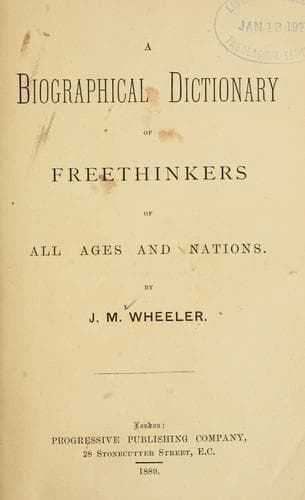
A Biographical Dictionary of Freethinkers of All Ages and NationsWheeler, J. M. (Joseph Mazzini)
Religion
A Biographical Dictionary of Freethinkers of All Ages and Nations
Wheeler, J. M. (Joseph Mazzini)
Free thought -- Biography
Pageze (L.) French Socialist; has written on the Concordat and the
Budget des Cultes, '86, Separation of Church and State, '87, etc.
Paine (Thomas), Deist, b. Thetford, Norfolk, 29 Jan., 1737. His father
was a Quaker and staymaker, and Paine was brought up to the trade. He
left home while still young, went to London and Sandwich, where he
married the daughter of an exciseman, and entered the excise. He
was selected by his official associates to embody their wants in a
paper, and on this work he displayed such talent that Franklin, then
in London, suggested America as a good field for his abilities. Paine
went in 1774, and soon found work for his pen. He became editor of the
Pennsylvanian Magazine and contributed to the Pennsylvanian journal
a strong anti-slavery essay. Common Sense, published early in 1776,
advocating absolute independence for America, did more than anything
else to precipitate the great events of that year. Each number of
the Crisis, which appeared during the war, was read by Washington's
order to each regiment in the service. Paine subscribed largely
to the army, and served for a short time himself. After peace was
declared, congress voted him three thousand dollars, and the state
of New York gave him a large farm. Paine turned his attention to
mechanics, and invented the tubular iron bridge, which he endeavored
to introduce in Europe. Reaching France during the Revolution,
he published a pamphlet advocating the abolition of royalty. In
1791 he published his Rights of Man, in reply to Burke. For this
he was outlawed. Escaping from England, he went to France, where he
was elected to the Convention. He stoutly opposed the execution of
the king, and was thrown by Robespierre into the Luxembourg prison,
where for nearly a year he awaited the guillotine. During this time
he wrote the first part of the Age of Reason, which he completed
on his release. This famous book, though vulnerable in some minor
points of criticism, throws a flood of light on Christian dogmas,
and has had a more extended sale than any other Freethought work. As
a natural consequence, Paine has been an object of incessant slander
by the clergy. Paine died at New York 8 June, 1809, and, by his own
direction was buried on his farm at New Rochelle. Cobbett is said to
have disinterred him and brought his bones to England.
Pajot (François). See Liniere.
Public-domain text, read in full here on John Shaqi.
Reviews
Reviews
No reviews yet
Be the first to share your thoughts on this work.
Elsewhere in the archive
Join the Discussion
Join the discussion
Sign in to leave a comment or review.
Sign InorCreate an account