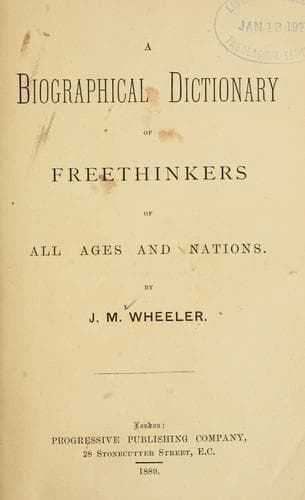
A Biographical Dictionary of Freethinkers of All Ages and NationsWheeler, J. M. (Joseph Mazzini)
Religion
A Biographical Dictionary of Freethinkers of All Ages and Nations
Wheeler, J. M. (Joseph Mazzini)
Free thought -- Biography
Pyrrho. Greek philosopher, a native of Elis, in Peloponesus, founder of
a sceptical school about the time of Epicurus; is said to have been
attracted to philosophy by the books of Democritus. He attached himself
to Anaxarchus, and joined her in the expedition of Alexander the Great,
and became acquainted with the philosophy of the Magi and the Indian
Gymnosophists. He taught the wisdom of doubt, the uncertainty of all
things, and the rejection of speculation. His disciples extolled his
equanimity and independence of externals. It is related that he kept
house with his sister, and shared with her in all domestic duties. He
reached the age of ninety years, and after his death the Athenians
honored him with a statue. He left no writings, but the tenets of his
school, which were much misrepresented, may be gathered from Sextus
and Empiricus.
Quental. See Anthero de Quental.
"Quepat (Nérée.") See Paquet (René).
Quesnay (François), French economist, b. Mérey, 4 June 1694. Self
educated he became a physician, but is chiefly noted for his Tableau
Economique, 1708, and his doctrine of Laissez Faire. He derived moral
and social rules from physical laws. Died Versailles, 16 Dec. 1774.
Quinet (Edgar), French writer, b. Bourgen Bresse, 17 Feb. 1803. He
attracted the notice of Cousin by a translation of Herder's The
Philosophy of History. With his friend Michelet he made many attacks
on Catholicism, the Jesuits being their joint work. He fought in
the Revolution of '48, and opposed the Second Empire. His work on
The Genius of Religion, '42, is profound, though mystical, and his
historical work on The Revolution, '65 is a masterpiece. Died at
Versailles, 27 March, 1875.
Quintin (Jean), Heretic of Picardy, and alleged founder of the
Libertines. He is said to have preached in Holland and Brabant in
1525, that religion was a human invention. Quintin was arrested and
burnt at Tournay in 1530.
Quris (Charles), French advocate of Angers, who has published some
works on law and La Défense Catholique et la Critique, Paris, 1864.
Rabelais (François), famous and witty French satirist and philosopher,
b. Chinon, Touraine, 7 Jan. 1495. At an early age he joined the order
of Franciscans, but finding monastic life incompatible with his genial
temper, quitted the convent without the leave of his superior. He
studied medicine at Montpelier about 1530, after which he practised
at Lyons. His great humorous work, published anonymously in 1535, was
denounced as heretical by the clergy for its satires, not only on their
order but their creed. The author was protected by Francis I. and was
appointed curé of Meudon. Died at Paris, 9 April, 1553. His writings
show surprising fertility of mind, and Coleridge says, "Beyond a
doubt he was among the deepest as well as boldest thinkers of his age."
Public-domain text, read in full here on John Shaqi.
Reviews
Reviews
No reviews yet
Be the first to share your thoughts on this work.
Elsewhere in the archive
Join the Discussion
Join the discussion
Sign in to leave a comment or review.
Sign InorCreate an account