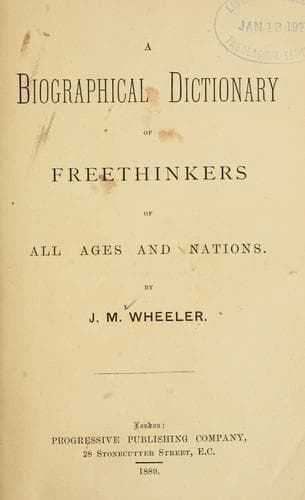
A Biographical Dictionary of Freethinkers of All Ages and NationsWheeler, J. M. (Joseph Mazzini)
Religion
A Biographical Dictionary of Freethinkers of All Ages and Nations
Wheeler, J. M. (Joseph Mazzini)
Free thought -- Biography
Reimarus (Hermann Samuel), German philologist, b. Hamburg, 22
Dec. 1694. He was a son-in-law of J. A. Fabricus. Studied at Jena and
Wittenberg; travelled in Holland and England; and was appointed rector
of the gymnasium in Weimar, 1723, and in Hamburg, 1729. He was one of
the most radical among German rationalists. He published a work on
The Principle Truths of Natural Religion, 1754, and left behind the
Wolfenbüttel Fragments, published by Lessing in 1777. Died at Hamburg,
1 March, 1768. Strauss has written an account of his services, 1862.
Reitzel (Robert), German American revolutionary, b. Baden, 1849. Named
after Blum, studied theology, went to America, walked from New
York to Baltimore, and was minister to an independent Protestant
church. Studied biology and resigned as a minister, and became speaker
of a Freethought congregation at Washington for seven years. Is now
editor of Der Arme Teufel of Detroit, and says he "shall be a poor
man and a Revolutionaire all my life."
Remsburg (John E.), American lecturer and writer, b. 1848. Has
written a series of pamphlets entitled The Image Breaker, False
Claims of the Christian Church, '83, Sabbath Breaking, Thomas Paine,
and a vigorous onslaught on Bible Morals, instancing twenty crimes
and vices sanctioned by scripture, '85.
Renan (Joseph Ernest), learned French writer, b. Tréguier (Brittany)
27 Feb. 1823. Was intended for the Church and went to Paris to
study. He became noted for his linguistic attainment, but his
studies and independence of thought did not accord with his intended
profession. My faith, he says was destroyed not by metaphysics
nor philosophy but by historical criticism. In '45 he gave up all
thoughts of an ecclesiastic career and became a teacher. In '48
he gained the Volney prize, for a memoir on the Semitic Languages,
afterwards amplified into a work on that subject. In '52 he published
his work on Averroës and Averroïsm. In '56 was elected member of
the Academy of Inscriptions, and in '60 sent on a mission to Syria;
having in the meantime published a translation of Job and Song of
Songs. Here he wrote his long contemplated Vie de Jesus, '63. In
'61 he had been appointed Professor of Hebrew in the Institute of
France, but denounced by bishops and clergy he was deprived of his
chair, which was, however, restored in '70. The Pope did not disdain
to attack him personally as a "French blasphemer." The Vie de Jesus
is part of a comprehensive History of the Origin of Christianity, in
8 vols., '63-83, which includes The Apostles, St Paul, Anti-Christ,
The Gospels, The Christian Church, and Marcus Aurelius, and the end
of the Antique World. Among his other works we must mention Studies on
Religious History ('58), Philosophical Dialogues and Fragments ('76),
Spinoza ('77), Caliban, a satirical drama ('80), the Hibbert Lecture
on the Influence of Rome on Christians, Souvenirs, '84; New Studies
of Religious History,'84; The Abbess of Jouarre, a drama which made
Public-domain text, read in full here on John Shaqi.
Reviews
Reviews
No reviews yet
Be the first to share your thoughts on this work.
Elsewhere in the archive
Join the Discussion
Join the discussion
Sign in to leave a comment or review.
Sign InorCreate an account