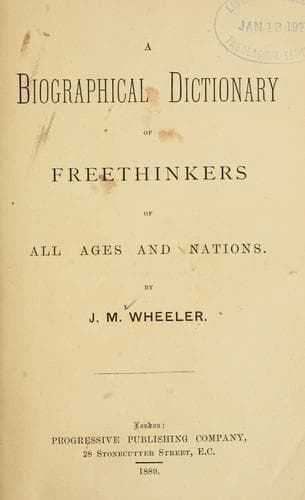
A Biographical Dictionary of Freethinkers of All Ages and NationsWheeler, J. M. (Joseph Mazzini)
Religion
A Biographical Dictionary of Freethinkers of All Ages and Nations
Wheeler, J. M. (Joseph Mazzini)
Free thought -- Biography
Rossmaessler (Emil Adolf), German naturalist b. Leipsic 3 March,
1806. Studied theology, but abandoned it for science, and wrote many
scientific works of repute. In '48 he was elected to Parliament. Among
his writings are Man in the Mirror of Nature. '49-55. The History of
the Earth, '68. Died as a philosopher 8 April, 1867.
Roth (Julius), Dr., German author of Religion and Priestcraft, Leipzig,
1869; Jesuitism, '71.
Rothenbuecher (Adolph), Dr., German author of an able little Handbook
of Morals, written from the Secular standpoint, Cottbus, 1884.
Rotteck (Karl Wenceslaus von), German historian and statesman
b. Freiburg 18 July, 1775. Studied in his native town, where in
1798 be became Professor of History. In 1819 he represented his
University in the States of Baden, where he distinguished himself by
his liberal views. He was forbidden by government to edit any paper
and was deprived of his chair. This persecution hastened his death,
which occurred 26 Nov 1840. Rotteck's General History of the World
(9 vols., 1827) was very popular and gave one of the broadest views
of history which had then appeared.
Rousseau (Jean Jacques), Swiss philosopher, b. Geneva, 28 June,
1712. After a varied career he went to Paris in 1741 and supported
himself. In 1751 he obtained a prize from the academy of Dijon for
negative answer to the question "whether the re-establishment of the
arts and sciences has conduced to the purity of morals." This success
prompted further literary efforts. He published a dictionary of music,
the New Heloise (1759), a love story in the form of letters, which
had great success, and Emilius (May 1762), a moral romance, in which
he condemns other education than that of following nature. In this
work occurs his Confession of Faith of a Savoyard Vicar, discarding
the supernatural element in Christianity. The French parliament
condemned the book 9 June, 1762, and prosecuted the writer, who fled
to Switzerland. Pope Clement XVIII fulminated against Emile, and
Rousseau received so many insults on account of his principles that
he returned to Paris and on the invitation of Hume came to England
in Jan. 1766. He knew little English and soon took offence with
Hume, and asked permission to return to Paris, which he obtained on
condition of never publishing anything more. He however completed his
Confessions, of which he had previously composed the first six books
in England. Rousseau was a sincere sentimentalist, an independent
and eloquent, but not deep thinker. His captious temper spoiled his
own life, but his influence has been profound and far-reaching. Died
near Paris, 2 July, 1778.
Rouzade (Leonie) Madame, French Freethought lecturess. Has written
several brochures and novels, notably Le Monde Renversé, 1872,
and Ci et ca, ca et la, ideas upon moral philosophy and social
progress. Writes in Malon's Revue Socialiste, and is one of the
editors of Les Droits des Femmes.
Public-domain text, read in full here on John Shaqi.
Reviews
Reviews
No reviews yet
Be the first to share your thoughts on this work.
Elsewhere in the archive
Join the Discussion
Join the discussion
Sign in to leave a comment or review.
Sign InorCreate an account