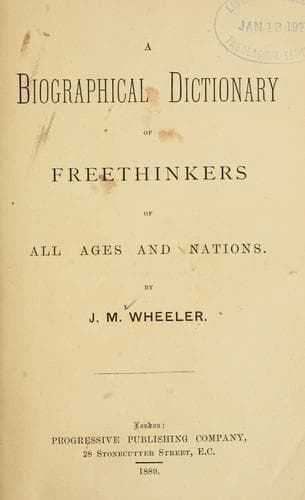
A Biographical Dictionary of Freethinkers of All Ages and NationsWheeler, J. M. (Joseph Mazzini)
Religion
A Biographical Dictionary of Freethinkers of All Ages and Nations
Wheeler, J. M. (Joseph Mazzini)
Free thought -- Biography
Ryall (Malthus Questell), was secretary of the Anti-Persecution Union,
1842, and assisted his friend Mr. Holyoake on The Oracle of Reason
and The Movement. Died 1846.
Rydberg (Abraham Viktor), Swedish man of Letters, b. Jönköping, 18
Dec. 1829. He has written many works of which we mention The Last
Athenian Roman Days, and The Magic of the Middle Ages, which have
been translated into English.
Rystwick (Herman van), early Dutch heretic who denied hell and
taught that the soul was not immortal, but the elements of all
matter eternal. He was sent to prison in 1499, and set at liberty
upon abjuring his opinion, but having published them a second time,
he was arrested at the Hague, and burnt to death in 1511.
Sabin (Ibn), Al Mursi, Spanish Arabian philosopher, b. Murcia about
1218 of noble family. About 1249 he corresponded with Frederick II.,
replying to his philosophical questions. Committed suicide about 1271.
Sadoc, a learned Jewish doctor in the third century B.C. He denied
the resurrection, the existence of angels, and the doctrine
of predestination, and opposed the idea of future rewards and
punishments. His followers were named after him, Sadducees.
Saga (Francesco) de Rovigo, Italian heretic, put to death for
Anti-Trinitarianism at Venice, 25 Feb. 1566.
Saigey (Emile), French inspector of telegraph wires. Wrote Modern
Physics, 1867, and The Sciences in the Eighteenth Century: Physics
of Voltaire, '74. Died 1875.
Saillard (F.), French author of The Revolution and the Church (Paris,
'69), and The Organisation of the Republic, '83.
Sainte Beuve (Charles Augustin), French critic and man of letters
b. Boulogne, 23 Dec. 1804. Educated in Paris, he studied medicine,
which he practised several years. A favorable review of V. Hugo's
Odes and Ballades gained him the intimacy of the Romantic school. As
a critic he made his mark in '28 with his Historical and Critical
Picture of French Poetry in the Sixteenth Century. His other principal
works are his History of Port Royal, '40-62; Literary Portraits,
'32-39; and Causeries du Lundi, '51-57. In '45 he was elected to the
Academy, and in '65 was made a senator. As a critic he was penetrative,
comprehensive, and impartial.
Saint Evremond (Charles de Marguetel de Saint Denis) seigneur de,
French man of letters, b. St. Denys-le-Guast (Normandy), 1 April,
1713. He studied law, but subsequently entered the army and became
major-general. He was confined in the Bastile for satirising Cardinal
Mazarin. In England he was well received at the court of Charles
II. He died in London, 20 Sept. 1703, and was buried in Westminster
Abbey. Asked on his death-bed if he wished to reconcile himself to God,
he replied, he desired to reconcile himself to appetite. His works,
consisting of essays, letters, poems, and dramas, were published in
3 vols. 1705.
Public-domain text, read in full here on John Shaqi.
Reviews
Reviews
No reviews yet
Be the first to share your thoughts on this work.
Elsewhere in the archive
Join the Discussion
Join the discussion
Sign in to leave a comment or review.
Sign InorCreate an account