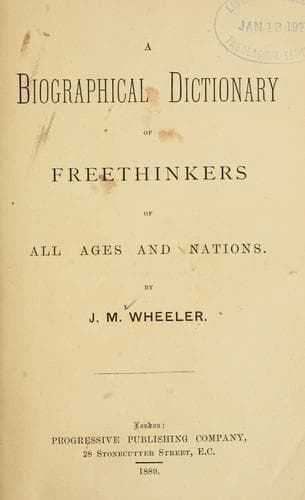
A Biographical Dictionary of Freethinkers of All Ages and NationsWheeler, J. M. (Joseph Mazzini)
Religion
A Biographical Dictionary of Freethinkers of All Ages and Nations
Wheeler, J. M. (Joseph Mazzini)
Free thought -- Biography
Sextus Empiricus, Greek sceptical philosopher and physician, who
probably lived early in the third century of the Christian era. He
left two works, one a summary of the doctrines of the sceptics in
three books; the other an attack on all positive philosophy.
Shadwell (Thomas), English dramatist, b. Straton Hall, Norfolk,
1640. Although damned by Dryden in his Mac Flecknoe, Shadwell's plays
are not without merit, and illustrate the days of Charles II. Died
6 Dec. 1692.
Shaftesbury (Anthony Ashley Cooper), third Earl, b. London, 26
Feb. 1671. Educated by Locke, in 1693 he was elected M.P. for Poole,
and proposed granting counsel to prisoners in case of treason. His
health suffering, he resigned and went to Holland, where he made the
acquaintance of Bayle. The excitement induced by the French Prophets
occasioned his Letters upon Enthusiasm, 1708. This was followed,
by his Moralists and Sensus Communis. In 1711 he removed to Naples,
where he died 4 Feb. 1713. His collected works were published under
the title of Characteristics, 1732. They went through several editions,
and did much to raise the character of English Deism.
Shakespeare (William). The greatest of all dramatists,
b. Stratford-on-Avon, 23 April, 1564. The materials for writing his
life are slender. He married in his 19th year, went to London, where he
became an actor and produced his marvellous plays, the eternal honor
of English literature. Shakespeare gained wealth and reputation and
retired to his native town, where he died April 23, 1616. His dramas
warrant the inference that he was a Freethinker. Prof. J. R. Green
says, "Often as his questionings turned to the riddle of life
and death, and leaves it a riddle to the last without heeding the
common theological solutions around him." His comprehensive mind
disdained endorsement of religious dogmas and his wit delighted in
what the Puritans call profanity. Mr. Birch in his Inquiry into the
Philosophy and Religion of Shakespeare, sustains the position that
he was an Atheist.
Shaw (James Dickson), American writer, b. Texas, 27 Dec. 1841. Brought
up on a cattle farm, at the Civil War he joined the Southern Army,
took part in some battles, and was wounded. He afterwards entered the
Methodist Episcopal ministry, '70; studied biblical criticism to answer
sceptics, and his own faith gave way. He left the Church in March,
'83, and started the Independent Pulpit at Waco, Texas, in which he
publishes bold Freethought articles. He rejects all supernaturalism,
and has written The Bible, What Is It?, Studies in Theology, The
Bible Against Itself, etc.
Public-domain text, read in full here on John Shaqi.
Reviews
Reviews
No reviews yet
Be the first to share your thoughts on this work.
Elsewhere in the archive
Join the Discussion
Join the discussion
Sign in to leave a comment or review.
Sign InorCreate an account