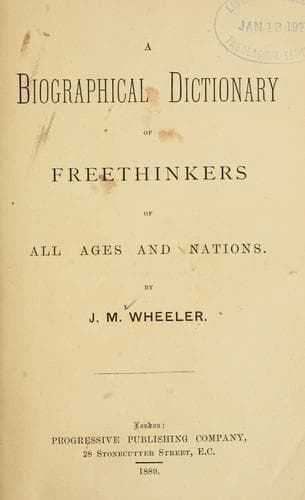
A Biographical Dictionary of Freethinkers of All Ages and NationsWheeler, J. M. (Joseph Mazzini)
Religion
A Biographical Dictionary of Freethinkers of All Ages and Nations
Wheeler, J. M. (Joseph Mazzini)
Free thought -- Biography
Spaventa (Bertrando), Italian philosopher, b. 1817. Since '61 he
has been professor of philosophy at Naples. Has written upon the
Philosophy of Kant, Gioberti, Spinoza, Hegel, etc. Died 1888.
Specht (Karl August), Dr. German writer, b. Lhweina, 2 July,
1845. Has been for many years editor of Menschenthum at Gotha, and
has written on Brain and Soul, Theology and Science and a Popular
History of the World's Development, which has gone through several
editions. Dr. Specht is a leading member of the German Freethinkers'
Union.
Spencer (Herbert), English philosopher, b. Derby, 1820. He was
articled to a civil engineer, but drifted into literature. He
wrote in the Westminster Review, and at the house of Dr. Chapman
met Mill, Lewes and "George Eliot." His first important work was
Social Statistics, '51. Four years later appeared his Principles of
Psychology, which with First Principles, '62; Principles of Biology,
'64; Principles of Sociology, '76-85, and Data of Ethics, '79, form
part of his "Synthetic Philosophy" in which he applies the doctrines
of evolution to the phenomena of mind and society no less than to
animal life. He has also published Essays, 3 vols, '58-74; a work on
Education '61; Recent Discussions on Science, Philosophy and Morals,
'71; The Study of Sociology, '72; Descriptive Sociology, '72-86,
an immense work compiled under his direction. Also papers directed
against Socialism; The Coming Slavery, '84; and Man and the State,
'85, and has contributed many articles to the best reviews.
Spinoza (Baruch), Pantheistic philosopher, b. of Jewish parents,
Amsterdam, 24 Nov. 1632. He early engaged in the study of theology and
philosophy, and, making no secret of his doubts, was excommunicated
by the Synagogue, 27 July, 1656. About the same time he narrowly
escaped death by a fanatic's dagger. To avoid persecution, he retired
to Rhinsburg, and devoted himself to philosophy, earning his living by
polishing lenses. About 1670 he settled at the Hague, where he remained
until his death. In 1670 he issued his Tractatus Theologico-politicus,
which made a great outcry; and for more than a century this great
thinker, whose life was gentle and self-denying, was stigmatized as
an atheist, a monster, and a blasphemer. A re-action followed, with
Lessing and Goethe, upon whom he had great influence. Though formerly
stigmatized as an atheist, Spinoza is now generally recognised as
among the greatest philosophers. He died in poverty at the Hague,
21 Feb. 1677. His Ethics was published with his Opera Posthuma. The
bi-centenary of his death was celebrated there by an eloquent address
from M. Rénan.
Spooner (Lysander), American writer, b. Athol (Mass.), 19
Jan. 1808. His first pamphlet was A Deist's Reply to the alleged
Supernatural Evidences of Christianity. He started letter-carrying from
Boston to New York, but was overwhelmed with prosecutions. He published
many works against slavery, and in favor of Individualism. Died at
Boston, 14 May, 1887.
Public-domain text, read in full here on John Shaqi.
Reviews
Reviews
No reviews yet
Be the first to share your thoughts on this work.
Elsewhere in the archive
Join the Discussion
Join the discussion
Sign in to leave a comment or review.
Sign InorCreate an account