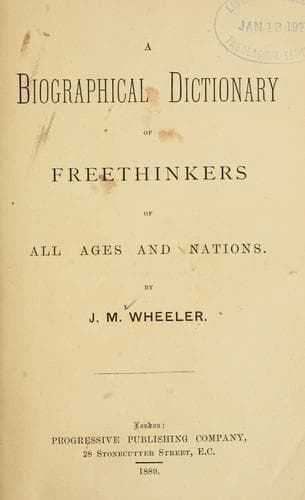
A Biographical Dictionary of Freethinkers of All Ages and NationsWheeler, J. M. (Joseph Mazzini)
Religion
A Biographical Dictionary of Freethinkers of All Ages and Nations
Wheeler, J. M. (Joseph Mazzini)
Free thought -- Biography
Tiele (Cornelis Petrus), Dutch scholar, b. Leyden, 16
Dec. 1830. Although brought up in the Church, his works all tell in
the service of Freethought, and he has shown his liberality of views
in editing the poems of Genestet together with his life, '68. He has
written many articles on comparative religion, and two of his works
have been translated into English, viz., Outlines of the History of
Religion, a valuable sketch of the old faiths, fourth ed. '88; and
Comparative History of the Egyptian and Mesopotamian Religions, '82.
Tillier (Claude), French writer, b. of poor parents, Clamecy,
11 April, 1801. He served as a conscript, and wrote some telling
pamphlets directed against tyranny and superstition, and some novels,
of which we note My Uncle Benjamin. Died at Nevers, 12 Oct. 1844. His
works were edited by F. Pyat.
Tindal (Matthew), LL.D., English Deist, b. Beer-ferris, Devon,
1657. Educated at Oxford, and at first a High Churchman, he was
induced to turn Romanist in the reign of James II., but returned to
Protestantism and wrote The Rights of the Christian Church. This work
was much attacked by the clergy, who even indicted the vendors. A
defence which he published was ordered to be burnt by the House of
Commons. In 1730 he published Christianity as Old as the Creation, to
which no less than 150 answers were published. He died 16 Aug. 1733,
and a second volume, which he left in MS., was destroyed by order of
Gibson, Bishop of London.
Toland (John), Irish writer, b. Redcastle, near Londonderry, 30
Nov. 1669. Educated as a Catholic, he renounced that faith in early
youth, went to Edinburgh University, where he became M.A. in 1690,
and proceeded to Leyden, studying under Spanheim, and becoming a
sceptic. He also studied at Oxford, reading deeply in the Bodleian
Library, and became the correspondent of Le Clerc and Bayle. In
1696 he startled the orthodox with his Christianity not Mysterious,
which was "presented" by the Grand Jury of Middlesex and condemned by
the Lower House of Convocation. The work was also burnt at Dublin,
Sept. 1697. He wrote a Life of Milton (1698), in which, mentioning
Eikon Basilike, he referred to the "suppositious pieces under the
name of Christ, his apostles and other great persons." For this he was
denounced by Dr. Blackhall before Parliament. He replied with Amytor,
in which he gives a catalogue of such pieces. He went abroad and
was well received by the Queen of Prussia, to whom he wrote Letters
to Serena (1704), which, says Lange, "handles the kernel of the
whole question of Materialism." In 1709 he published Adeisidænon and
Origines Judaicæ. In 1718 Nazarenus, on Jewish, Gentile and Mahommedan
Christianity, in which he gave an account of the Gospel of Barnabus. He
also wrote four pieces entitled Tetradymus and Pantheisticon, which
described a society of Pantheists with a liturgy burlesquing that
of the Catholics. Toland died with the calmness of a philosopher,
at Putney, 11 March, 1722.
Public-domain text, read in full here on John Shaqi.
Reviews
Reviews
No reviews yet
Be the first to share your thoughts on this work.
Elsewhere in the archive
Join the Discussion
Join the discussion
Sign in to leave a comment or review.
Sign InorCreate an account