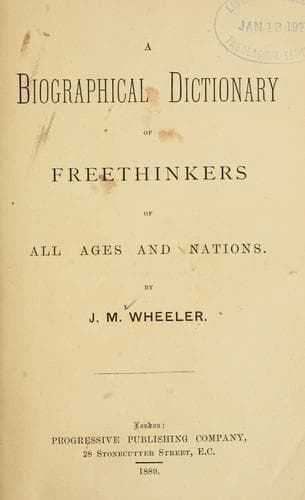
A Biographical Dictionary of Freethinkers of All Ages and NationsWheeler, J. M. (Joseph Mazzini)
Religion
A Biographical Dictionary of Freethinkers of All Ages and Nations
Wheeler, J. M. (Joseph Mazzini)
Free thought -- Biography
Vanini (Lucilio, afterwards Julius Cæsar), Italian philosopher and
martyr, b. Taurisano (Otranto), 1585. At Rome and Padua he studied
Averroism, entered the Carmelite order, and travelled in Switzerland,
Germany, Holland and France making himself admired and respected by
his rationalistic opinions. He returned to Italy in 1611, but the
Inquisition was on his track and he took refuge at Venice. In 1612 he
visited England, and in 1614 got lodged in the Tower. When released
he went to Paris and published a Pantheistic work in Latin On the
Admirable Secrets of Nature, the Queen and Goddess of Mortals. It was
condemned by the Sorbonne and burnt, and he fled to Toulouse in 1617;
but there was no repose for Freethought. He was accused of instilling
Atheism into his scholars, tried and condemned to have his tongue cut
out, his body burned and his ashes scattered to the four winds. This
was done 19 Feb. 1619. President Gramond, author of History of France
under Louis XIII., writes "I saw him in the tumbril as they led him
to execution, mocking the Cordelier who had been sent to exhort him
to repentance, and insulting our Savior by these impious words. 'He
sweated with fear and weakness, and I die undaunted.'"
Vapereau (Louis Gustave), French man of letters, b. Orleans 4 April,
1819. In '41 he became the secretary of Victor Cousin. He collaborated
on the Dictionnaire des Sciences Philosophiques and the Liberté
de Penser, but is best known by his useful Dictionnaire Universel
des Contemporains. In '70 he was nominated prefect of Cantal, but
on account of the violent attacks of the clericals was suspended in
'73 and resumed his literary labors, compiling a Universal Dictionary
of Writers, '76, and Elements of the History of French Literature,
1883-85.
Varnhagen von Ense (Earl August Ludwig Philipp), German author,
b. Dusseldorf, 21 Feb. 1785. He studied medicine and philosophy,
entered the Austrian and Russian armies, and served in the Prussian
diplomatic service. He was an intimate friend of Alex. von Humboldt,
and shared his Freethinking opinions. Died in Berlin, 10 Oct. 1858. He
vividly depicts the men and events of his time in his Diary.
Vauvenargues (Luc de Clapiers), Marquis; French moralist, b. Aix,
6 Aug. 1715. At eighteen he entered the army, and left the service
with ruined health in 1743. He published in 1746 an Introduction to
the Knowledge of the Human Mind, followed by Reflections and Maxims,
which was deservedly praised by his friend Voltaire. Died at Paris 28
May, 1747. His work, which though but mildly deistic, was rigorously
suppressed, and was reprinted about 1770.
Velthuysen (Lambert), Dutch physician, b. Utrecht, 1622. He wrote
many works on theology and philosophy in Latin. His works, De Officio
Pastorum and De Idolatria et Superstitione were proceeded against in
1668, but he was let off with a fine. Died 1685.
Venetianer (Moritz), German Pantheist, author of Der Allgeist, 1874,
and a work on Schopenhauer as a Scholastic.
Public-domain text, read in full here on John Shaqi.
Reviews
Reviews
No reviews yet
Be the first to share your thoughts on this work.
Elsewhere in the archive
Join the Discussion
Join the discussion
Sign in to leave a comment or review.
Sign InorCreate an account