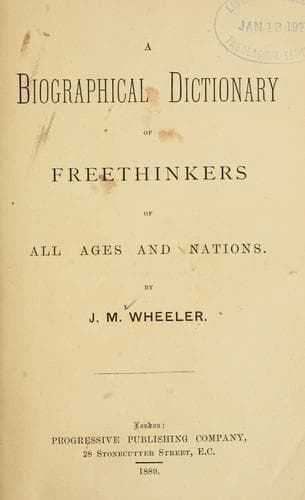
A Biographical Dictionary of Freethinkers of All Ages and NationsWheeler, J. M. (Joseph Mazzini)
Religion
A Biographical Dictionary of Freethinkers of All Ages and Nations
Wheeler, J. M. (Joseph Mazzini)
Free thought -- Biography
Broussais (François Joseph Victor), French physician and philosopher,
b. Saint Malo, 17 Dec. 1772. Educated at Dinan, in 1792 he served
as volunteer in the army of the Republic. He studied medicine at
St. Malo and Brest, and became a naval surgeon. A disciple of Bichat,
he did much to reform medical science by his Examination of Received
Medical Doctrines and to find a basis for mental and moral science in
physiology by his many scientific works. Despite his bold opinions, he
was made Commander of the Legion of Honor. He died poor at St. Malo 17
Nov. 1838, leaving behind a profession of faith, in which he declares
his disbelief in a creator and his being "without hope or fear of
another life."
Brown (George William), Dr., of Rockford, Illinois, b. in Essex Co.,
N.Y., Oct. 1820, of Baptist parents. At 17 years of age he was expelled
the church for repudiating the dogma of an endless hell. Dr. Brown
edited the Herald of Freedom, Kansas. In 1856 his office was destroyed
by a pro-slavery mob, his type thrown into the river, and himself
and others arrested but was released without trial. Dr. Brown has
contributed largely to the Ironclad Age and other American Freethought
papers, and is bringing out a work on the Origin of Christianity.
Brown (Titus L.), Dr., b. 16 Oct. 1823, at Hillside (N.Y.). Studied
at the Medical College of New York and graduated at the Homoeopathic
College, Philadelphia. He settled at Binghamton where he had a large
practice. He contributed to the Boston Investigator and in 1877 was
elected President of the Freethinkers Association. Died 17 Aug. 1887.
Browne (Sir Thomas), physician and writer, b. London, 19 Oct. 1605. He
studied medicine and travelled on the Continent, taking his doctor's
degree at Leyden (1633). He finally settled at Norwich, where he had
a good practice. His treatise Religio Medici, famous for its fine
style and curious mixture of faith and scepticism, was surreptitiously
published in 1642. It ran through several editions and was placed on
the Roman Index. His Pseudodoxia Epidemica; Enquiries into Vulgar
and Common Errors, appeared in 1646. While disputing many popular
superstitions he showed he partook of others. This curious work
was followed by Hydriotaphia, or Urn-Burial, in which he treats
of cremation among the ancients. To this was added The Garden of
Cyrus. He died 19 Oct. 1682.
Public-domain text, read in full here on John Shaqi.
Reviews
Reviews
No reviews yet
Be the first to share your thoughts on this work.
Join the Discussion
Join the discussion
Sign in to leave a comment or review.
Sign InorCreate an account