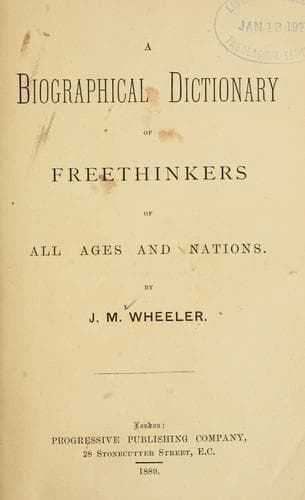
A Biographical Dictionary of Freethinkers of All Ages and NationsWheeler, J. M. (Joseph Mazzini)
Religion
A Biographical Dictionary of Freethinkers of All Ages and Nations
Wheeler, J. M. (Joseph Mazzini)
Free thought -- Biography
Burdach (Karl Friedrich), German physiologist, b. Leipsic 12 June,
1776. He occupied a chair at the University of Breslau. His works on
physiology and anthropology did much to popularise those sciences,
and the former is placed on the Index Librorum Prohibitorum for its
materialistic tendency. He died at Konigsberg, 16 July, 1847.
Burdon (William), M.A., writer, b. Newcastle, 11 Sept. 1764. Graduated
at Emmanuel College, Cambridge, 1788. He was intended for a clergyman,
but want of faith made him decline that profession. His principal work
is entitled Materials for Thinking. Colton largely availed himself of
this work in his Lacon. It went through five editions in his lifetime,
and portions were reprinted in the Library of Reason. He also addressed
Three Letters to the Bishop of Llandaff, wrote a Life and Character of
Bonaparte, translated an account of the Revolution in Spain, edited the
Memoirs of Count Boruwlaski, and wrote some objections to the annual
subscription to the Sons of the Clergy. Died in London, 30 May, 1818.
Burigny (Jean Levesque de), French writer, b. Rheims, 1692. He became
a member of the French Academy, wrote a treatise on the Authority
of the Pope, a History of Pagan Philosophy and other works, and
is credited with the Critical Examination of the Apologists of the
Christian Religion, published under the name of Freret by Naigeon,
1766. Levesque de Burigny wrote a letter in answer to Bergier's
Proofs of Christianity, which is published in Naigeon's Recueil
Philosophique. Died at Paris, 8 Oct. 1785.
Burmeister (Hermann), German naturalist, b. Stralsund, 15 Jan. 1807. In
1827 he became a doctor at Halle. In '48 he was elected to the National
Assembly. In 1850 he went to Brazil. His principal work is The History
of Creation, 1843.
Burmeister or Baurmeister (Johann Peter Theodor) a German Rationalist
and colleague of Ronge. Born at Flensburg, 1805. He resided in
Hamburg, and wrote in the middle of the present century under the
name of J. P. Lyser.
Burnet (Thomas), b. about 1635 at Croft, Yorkshire. Through the
interest of a pupil, the Duke of Ormonde, he obtained the mastership
of the Charterhouse, 1685. In 1681 the first part of his Telluris
Theoria Sacra, or Sacred Theory of the Earth, appeared in Latin, and
was translated and modified in 1684. In 1692 Burnet published, both
in English and in Latin, his Archæologiæ Philosophicæ, or the Ancient
Doctrine of the Origin of Things. He professes in this to reconcile
his theory with Genesis, which receives a figurative interpretation;
and a ludicrous dialogue between Eve and the serpent gave great
offence. In a popular ballad Burnet is represented as saying--
That all the books of Moses
Were nothing but supposes.
Public-domain text, read in full here on John Shaqi.
Reviews
Reviews
No reviews yet
Be the first to share your thoughts on this work.
Elsewhere in the archive
Join the Discussion
Join the discussion
Sign in to leave a comment or review.
Sign InorCreate an account