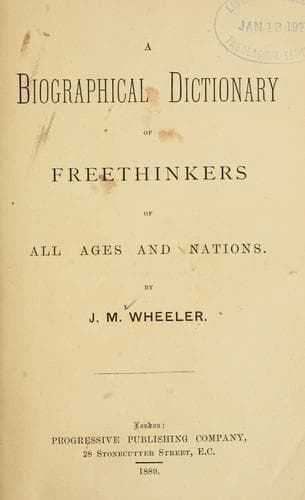
A Biographical Dictionary of Freethinkers of All Ages and NationsWheeler, J. M. (Joseph Mazzini)
Religion
A Biographical Dictionary of Freethinkers of All Ages and Nations
Wheeler, J. M. (Joseph Mazzini)
Free thought -- Biography
He had to resign a position at court. In later life he wrote De Fide
et Officiis Christianorum (on Christian Faith and Duties), in which
he regards historical religions as based on the religion of nature,
and rejects original sin and the "magical" theory of sacraments;
and De Statu Mortuorum et Resurgentium, on the State of the Dead and
Resurrected, in which he opposed the doctrine of eternal punishment
and shadowed forth a scheme of Deism. These books he kept to himself
to avoid a prosecution for heresy, but had a few copies printed for
private friends. He died in the Charterhouse 27 Sept. 1715. A tract
entitled Hell Torments not Eternal was published in 1739.
Burnett (James), Lord Monboddo, a learned Scotch writer and judge,
was b. Monboddo, Oct. 1714. He adopted the law as his profession,
became a celebrated advocate, and was made a judge in 1767. His
work on the Origin and Progress of Language (published anonymously
1773-92), excited much derision by his studying man as one of the
animals and collecting facts about savage tribes to throw light on
civilisation. He first maintained that the orang-outang was allied
to the human species. He also wrote on Ancient Metaphysics. He was
a keen debater and discussed with Hume, Adam Smith, Robertson, and
Lord Kames. Died in Edinburgh, 26 May, 1799.
Burnouf (Emile Louis), French writer, b. Valonges, 25 Aug. 1821. He
became professor of ancient literature to the faculty of Nancy. Author
of many works, including a translation of selections from the Novum
Organum of Bacon, the Bhagvat-Gita, an Introduction to the Vedas,
a history of Greek Literature, Studies in Japanese, and articles
in the Revue des deux Mondes. His heresy is pronounced in his work
on the Science of Religions, 1878, in his Contemporary Catholicism,
and Life and Thought, 1886.
Burnouf (Eugène), French Orientalist, cousin of the preceding;
b. Paris, 12 Aug. 1801. He opened up to the Western world the Pali
language, and with it the treasures of Buddhism, whose essentially
Atheistic character he maintained. To him also we are largely indebted
for a knowledge of Zend and of the Avesta of the Zoroastrians. He
translated numerous Oriental works and wrote a valuable Introduction
to the History of Indian Buddhism. Died at Paris, 28 May, 1852.
Burns (Robert), Scotland's greatest poet, b. near Ayr, 25
Jan. 1759. His father was a small farmer, of enlightened views. The
life and works of Burns are known throughout the world. His
Freethought is evident from such productions as the "Holy Fair,"
"The Kirk's Alarm," and "Holy Willie's Prayer," and many passages in
private letters to his most familiar male friends. Died at Dumfries,
21 July, 1796.
Public-domain text, read in full here on John Shaqi.
Reviews
Reviews
No reviews yet
Be the first to share your thoughts on this work.
Elsewhere in the archive
Join the Discussion
Join the discussion
Sign in to leave a comment or review.
Sign InorCreate an account