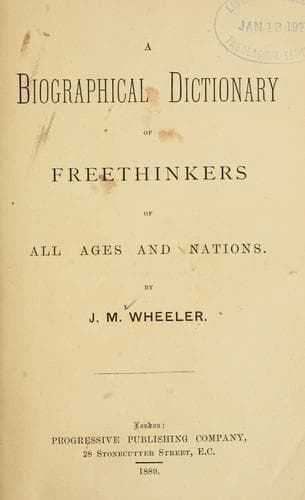
A Biographical Dictionary of Freethinkers of All Ages and NationsWheeler, J. M. (Joseph Mazzini)
Religion
A Biographical Dictionary of Freethinkers of All Ages and Nations
Wheeler, J. M. (Joseph Mazzini)
Free thought -- Biography
Buzot (François Léonard Nicolas), French Girondin, distinguished as
an ardent Republican and a friend and lover of Madame Roland. Born
at Evreux, 1 March, 1760; he died from starvation when hiding after
the suppression of his party June, 1793.
Byelinsky (Vissarion G.) See Belinsky.
Byron (George Gordon Noel) Lord, b. London, 22 Jan. 1788. He succeeded
his grand-uncle William in 1798; was sent to Harrow and Cambridge. In
1807 he published his Hours of Idleness, and awoke one morning to find
himself famous. His power was, however, first shown in his English
Bards and Scotch Reviewers, in which he satirised his critics, 1809. He
then travelled on the Continent, the result of which was seen in his
Childe Harold's Pilgrimage and other works. He married 2 Jan. 1815,
but a separation took place in the following year. Lord Byron then
resided in Italy, where he made the acquaintance of Shelley. In 1823
he devoted his name and fortune to the cause of the Greek revolution,
but was seized with fever and died at Missolonghi, 19 April, 1824. His
drama of Cain: a Mystery, 1822, is his most serious utterance,
and it shows a profound contempt for religious dogma. This feeling
is also exhibited in his magnificent burlesque poem, The Vision
of Judgment, which places him at the head of English satirists. In
his letters to the Rev. Francis Hodgson, 1811, he distinctly says:
"I do not believe in any revealed religion.... I will have nothing
to do with your immortality; we are miserable enough in this life,
without the absurdity of speculating upon another.... The basis of
your religion is injustice; the Son of God, the pure, the immaculate,
the innocent, is sacrificed for the guilty," etc.
Cabanis (Pierre Jean George), called by Lange "the father of the
materialistic physiology," b. Conac, 5 June, 1757. Became pupil
of Condillac and friend of Mirabeau, whom he attended in his last
illness, of which he published an account 1791. He was also intimate
with Turgot, Condorcet, Holbach, Diderot, and other distinguished
Freethinkers, and was elected member of the Institute and of the
Council of Five Hundred in the Revolution. His works are mostly
medical, the chief being Des Rapports du Physique et du Morale de
l'Homme, in which he contends that thoughts are a secretion of the
brain. Died Rueil, near Paris, 5 May, 1808.
Cæsalpinus (Andreas), Italian philosopher of the Renaissance,
b. Arezzo, Tuscany, 1519. He became Professor of Botany at Pisa, and
Linnæus admits his obligations to his work, De Plantis, 1583. He also
wrote works on metals and medicine, and showed acquaintance with the
circulation of the blood. In a work entitled Demonum Investigatio,
he contends that "possession" by devils is amenable to medical
treatment. His Quæstionum Peripateticarum, in five books, Geneva,
1568, was condemned as teaching a Pantheistic doctrine similar to
that of Spinoza. Bishop Parker denounced him. Died 23 Feb. 1603.
Public-domain text, read in full here on John Shaqi.
Reviews
Reviews
No reviews yet
Be the first to share your thoughts on this work.
Elsewhere in the archive
Join the Discussion
Join the discussion
Sign in to leave a comment or review.
Sign InorCreate an account