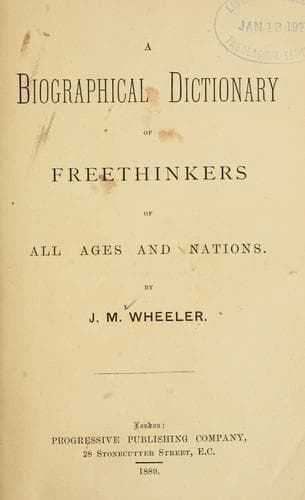
A Biographical Dictionary of Freethinkers of All Ages and NationsWheeler, J. M. (Joseph Mazzini)
Religion
A Biographical Dictionary of Freethinkers of All Ages and Nations
Wheeler, J. M. (Joseph Mazzini)
Free thought -- Biography
Cæsar (Caius Julius), the "foremost man of all this world," equally
renowned as soldier, statesman, orator, and writer, b. 12 July,
100 B.C., of noble family. His life, the particulars of which are
well known, was an extraordinary display of versatility, energy,
courage, and magnanimity. He justified the well-known line of Pope,
"Cæsar the world's great master and his own." His military talents
elevated him to the post of dictator, but this served to raise against
him a band of aristocratic conspirators, by whom he was assassinated,
15 March, 44 B.C. His Commentaries are a model of insight and clear
expression. Sallust relates that he questioned the existence of
a future state in the presence of the Roman senate. Froude says:
"His own writings contain nothing to indicate that he himself had any
religious belief at all. He saw no evidence that the gods practically
interfered in human affairs.... He held to the facts of this life and
to his own convictions; and as he found no reason for supposing that
there was a life beyond the grave he did not pretend to expect it."
Cahuac (John), bookseller, revised an edition of Palmer's Principles
of Nature, 1819. For this he was prosecuted at the instance of the
"Vice Society," but the matter was compromised. He was also prosecuted
for selling the Republican, 1820.
Calderino (Domizio), a learned writer of the Renaissance, b. in 1445,
in the territory of Verona, and lived at Rome, where he was professor
of literature, in 1477. He edited and commented upon many of the
Latin poets. Bayle says he was without religion. Died in 1478.
Calenzio (Eliseo), an Italian writer, b. in the kingdom of Naples about
1440. He was preceptor to Prince Frederic, the son of Ferdinand, the
King of Naples. He died in 1503, leaving behind a number of satires,
fables and epigrams, some of which are directed against the Church.
Call (Wathen Mark Wilks), English author, b. 7 June, 1817. Educated at
Cambridge, entered the ministry in 1843, but resigned his curacy about
1856 on account of his change of opinions, which he recounts in his
preface to Reverberations, 1876. Mr. Call is of the Positivist school,
and has contributed largely to the Fortnightly and Westminster Reviews.
Callet (Pierre Auguste), French politician, b. St. Etienne, 27
Oct. 1812; became editor of the Gazette of France till 1840. In 1848
he was nominated Republican representative. At the coup d'état of 2
Dec. 1851, he took refuge in Belgium. He returned to France, but was
imprisoned for writing against the Empire. In 1871, Callet was again
elected representative for the department of the Loire. His chief
Freethought work is L'Enfer, an attack upon the Christian doctrine
of hell, 1861.
Camisani (Gregorio), Italian writer, b. at Venice, 1810. A Professor
of Languages in Milan. He has translated the Upas of Captain R. H. Dyas
and other works.
Public-domain text, read in full here on John Shaqi.
Reviews
Reviews
No reviews yet
Be the first to share your thoughts on this work.
Elsewhere in the archive
Join the Discussion
Join the discussion
Sign in to leave a comment or review.
Sign InorCreate an account