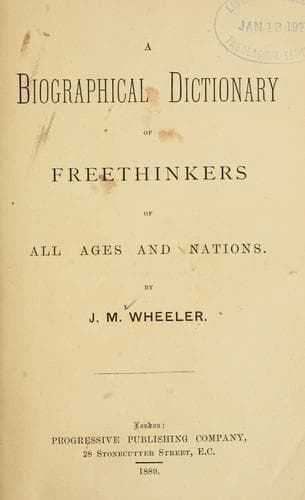
A Biographical Dictionary of Freethinkers of All Ages and NationsWheeler, J. M. (Joseph Mazzini)
Religion
A Biographical Dictionary of Freethinkers of All Ages and Nations
Wheeler, J. M. (Joseph Mazzini)
Free thought -- Biography
Carlyle (Thomas), one of the most gifted and original writers of the
century, b. 4 Dec. 1795, at Ecclefechan, Dumfriesshire, where his
father, a man of intellect and piety, held a small farm. Showing early
ability he was intended for the Kirk, and educated at the University
of Edinburgh. He, however, became a tutor, and occupied his leisure
in translating from the German. He married Jane Welsh 17 Oct. 1826,
and wrote in the London Magazine and Edinburgh Review many masterly
critical articles, notably on Voltaire, Diderot, Burns, and German
literature. In 1833-4 his Sartor Resartus appeared in Fraser's
Magazine. In '34 he removed to London and began writing the French
Revolution, the MS. of the first vol. of which he confided to Mill,
with whom it was accidentally burnt. He re-wrote the work without
complaint, and it was published in '37. He then delivered a course
of lectures on "German Literature" and on "Heroes, Hero-Worship, and
the Heroic in History," in which he treats Mahomet as the prophet
"we are freest to speak of." His Past and Present was published in
'43. In '45 appeared Oliver Cromwell's Letters and Speeches. In
'50 he published Latter-Day Pamphlets, which contains his most
distinctive political and social doctrines, and in the following year
his Life of John Sterling, in which his heresy clearly appears. His
largest work is his History of the Life and Times of Frederick the
Great, in 10 vols. He was elected rector of Edinburgh University in
'65. Died 5 Feb. 1881. Mr. Froude, in his Biography of Carlyle, says,
"We have seen him confessing to Irving that he did not believe as his
friend did in the Christian religion." ... "the special miraculous
occurrences of sacred history were not credible to him."
Carneades, sceptical philosopher, b. Cyrene about B.C. 213. He went
early to Athens, and attended the lectures of the Stoics, learning
logic from Diogenes. In the year 155, he was chosen with other
deputies to go to Rome to deprecate a fine which had been placed on
the Athenians. During his stay at Rome he attracted great attention
by his philosophical orations. Carneades attacked the very idea of
a God at once infinite and an individual. He denied providence and
design. Many of his arguments are preserved in Cicero's Academics
and De Natura Deorum. Carneades left no written works; his views
seem to have been systematised by his follower Clitomachus. He died
B.C. 129. Carneades is described as a man of unwearied industry. His
ethics were of elevated character.
Carneri (Bartholomäus von), German writer, b. Trieste, 3
Nov. 1821. Educated at Vienna. In 1870 he sat in the Austrian
Parliament with the Liberals. Author of an able work on Morality and
Darwinism, Vienna, 1871. Has also written Der Mensch als Selbstweck,
"Humanity as its own proper object," 1877; Grundlegung der Ethik,
Foundation of Morals, 1881; and Ethical Essays on Evolution and
Happiness, Stuttgart, 1886.
Public-domain text, read in full here on John Shaqi.
Reviews
Reviews
No reviews yet
Be the first to share your thoughts on this work.
Elsewhere in the archive
Join the Discussion
Join the discussion
Sign in to leave a comment or review.
Sign InorCreate an account