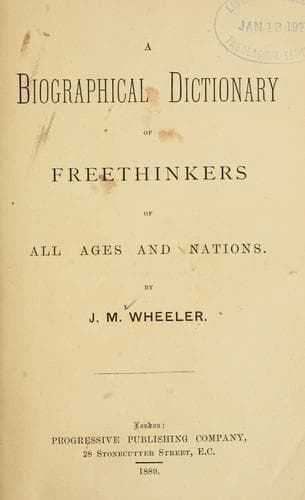
A Biographical Dictionary of Freethinkers of All Ages and NationsWheeler, J. M. (Joseph Mazzini)
Religion
A Biographical Dictionary of Freethinkers of All Ages and Nations
Wheeler, J. M. (Joseph Mazzini)
Free thought -- Biography
Desbarreaux (Jacques Vallée), Seigneur, French poet and sceptic,
b. Paris, 1602, great-nephew of Geoffrey Vallée, who was burnt in
1574. Many stories are related of his impiety, e.g. the well-known
one of his having a feast of eggs and bacon. It thundered, and Des
Barreaux, throwing the plate out of window, exclaimed, "What an amount
of noise over an omelette." It was said he recanted and wrote a poem
beginning, "Great God, how just are thy chastisements." Voltaire,
however, assigns this poem to the Abbé Levau. Died at Chalons,
9 May, 1673.
Descartes (René), French philosopher, b. at La Haye, 31 March,
1596. After leaving college he entered the army in '16, and fought
in the battle of Prague. He travelled in France and Italy, and in
'29 settled in Holland. In '37 he produced his famous Discourses upon
the Method of Reasoning Well, etc., and in '41 his Meditations upon
First Philosophy. This work gave such offence to the clergy that he
was forced to fly his country "parce qu'il y fait trop chaud pour
lui." He burnt his Traite du Monde (Treatise on the World) lest
he should incur the fate of Gallilei. Though a Theist, like Bacon,
he puts aside final causes. He was offered an asylum by Christina,
Queen of Sweden, and died at Stockholm 11 Feb. 1650.
Deschamps (Léger-Marie), known also as Dom Deschamps, a French
philosopher, b. Rennes, Poitiers, 10 Jan. 1716. He entered the Order
of Benedictines, but lost his faith by reading an abridgment of
the Old Testament. He became correspondent of Voltaire, Rousseau,
d'Alembert, Helvetius, and other philosophers. "Ce prêtre athée,"
as Ad. Franck calls him, was the author of a treatise entitled La
Vérité, ou le Vrai Système, in which he appears to have anticipated
all the leading ideas of Hegel. God, he says, as separated from
existing things, is pure nothingness. An analysis of his remarkable
work, which remained in manuscript for three-quarters of a century,
has been published by Professor Beaussire (Paris, 1855). Died at
Montreuil-Bellay, 19 April 1774.
Deslandes (André François Boureau), b. Pondichery, 1690. Became member
of the Berlin Academy and wrote numerous works, mostly under the veil
of anonymity, the principal being A Critical History of Philosophy,
3 vols(1737). His Pygmalion, a philosophical romance, was condemned by
the parliament of Dijon, 1742. His Reflexions sur les grands hommes
qui sont mort en Plaisantant (Amsterdam, 1732) was translated into
English and published in 1745 under the title, Dying Merrily. Another
work directed against religion was On the certainty of Human Knowledge,
a philosophical examination of the different prerogatives of reason
and faith (London, 1741). Died Paris, 11 April, 1757.
Public-domain text, read in full here on John Shaqi.
Reviews
Reviews
No reviews yet
Be the first to share your thoughts on this work.
Elsewhere in the archive
Join the Discussion
Join the discussion
Sign in to leave a comment or review.
Sign InorCreate an account