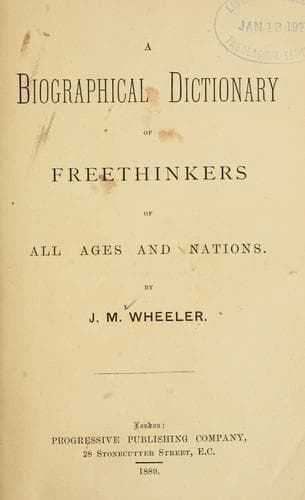
A Biographical Dictionary of Freethinkers of All Ages and NationsWheeler, J. M. (Joseph Mazzini)
Religion
A Biographical Dictionary of Freethinkers of All Ages and Nations
Wheeler, J. M. (Joseph Mazzini)
Free thought -- Biography
Diagoras, Greek poet, philosopher, and orator, known as "the Atheist,"
b. Melos. A pupil of Democritus, who is said to have freed him from
slavery. A doubtful tradition reports that he became an Atheist after
being the victim of an unpunished perjury. He was accused (B.C. 411)
of impiety, and had to fly from Athens to Corinth, where he died. A
price was put upon the Atheist's head. His works are not extant,
but several anecdotes are related of him, as that he threw a wooden
statue of Hercules into the fire to cook a dish of lentils, saying the
god had a thirteenth task to perform; and that, being on his flight
by sea overtaken by a storm, hearing his fellow-passengers say it
was because an Atheist was on board, he pointed to other vessels
struggling in the same storm without being laden with a Diagoras.
Di Cagno Politi (Niccola Annibale), Italian Positivist, b. Bari,
1857. Studied at Naples under Angiulli, has written on modern culture
and on experimental philosophy in Italy, and contributed articles on
Positivism to the Rivista Europea.
Diderot (Denis), French philosopher, b. Langres, 6 Oct. 1713. His
father, a cutler, intended him for the Church. Educated by Jesuits,
at the age of twelve he received the tonsure. He had a passion for
books, but, instead of becoming a Jesuit, went to Paris, where he
supported himself by teaching and translating. In 1746 he published
Philosophic Thoughts, which was condemned to be burnt. It did much
to advance freedom of opinion. Three years later his Letters on the
Blind occasioned his imprisonment at Vincennes for its materialistic
Atheism. Rousseau, who called him "a transcendent genius," visited
Diderot in prison, where he remained three years. Diderot projected the
famous Encyclopédie, which he edited with Alembert, and he contributed
some of the most important articles. With very inadequate recompense,
and amidst difficulties that would have appalled an ordinary editor,
Diderot superintended the undertaking for many years (1751-65). He also
contributed to other important works, such as Raynal's Philosophic
History, L'Esprit, by Helvetius, and The System of Nature and other
works of his friend D'Holbach. Diderot's fertile mind also produced
dramas, essays, sketches, and novels. Died 30 July, 1784. Comte calls
Diderot "the greatest thinker of the eighteenth century."
Diercks (Gustav), German author of able works on the History of the
Development of Human Spirit (Berlin, 1881-2) and on Arabian Culture
in Spain, 1887. Is a member of the German Freethinkers' Union.
Dilke (Ashton Wentworth), b. 1850. Educated at Cambridge, travelled
in Russia and Central Asia, and published a translation of Turgenev's
Virgin Soil. He purchased and edited the Weekly Dispatch; was returned
as M.P. for Newcastle in 1880, but, owing to ill health, resigned in
favor of John Morley, and died at Algiers 12 March, 1883.
Public-domain text, read in full here on John Shaqi.
Reviews
Reviews
No reviews yet
Be the first to share your thoughts on this work.
Elsewhere in the archive
Join the Discussion
Join the discussion
Sign in to leave a comment or review.
Sign InorCreate an account