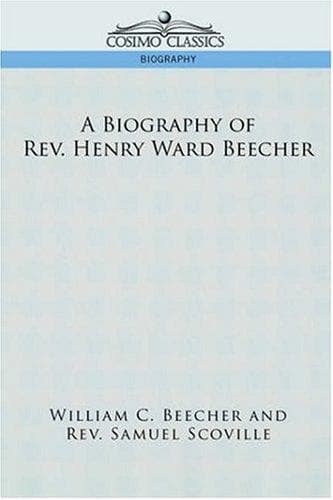
A Biography of Rev. Henry Ward BeecherScoville, Samuel
Religion
A Biography of Rev. Henry Ward Beecher
Scoville, Samuel
Beecher, Henry Ward, 1813-1887
“He also engaged in the publication of an agricultural paper, the
_Indiana Farmer_, and, as far as known, was the only professional man
who ever put practical sense into a periodical of the sort. A keen lover
of nature, he may be said to have put his heart in the work and made it
a memorable success.
“I do not remember his making any political speeches, although it is
well known that his church was the favorite resort of statesmen, who
made a study of his oratory and diction for their own benefit. I know
that he was deeply interested in all charitable enterprises,
particularly the benevolent institutions that are now the pride of the
State.
“Nor am I aware that he ever addressed the legislative bodies in
particular, although the General Assembly men attended his church almost
in a body. He was known as a Whig, but was not pronounced in that
direction.
“The heart-felt interest he took in the slavery question was well known.
About the year 1842 a roving commission of Abolitionists from the East
visited Indianapolis. They held a meeting on the State House grounds,
and I remember seeing Mr. Beecher a prominent figure on the platform.
“The unpopularity of the Abolition cause at that time cannot easily be
imagined. To be identified with it was to be socially ostracized and
boycotted generally. It required the courage of a martyr to be an
Abolitionist. As notable examples may be cited two physicians who were
members of Mr. Beecher’s church. Bold enough to avow their principles,
they were exceedingly unpopular with the masses, and in their struggle
to combat popular opinion found it extremely difficult to support
themselves and families. They literally had no practice. The manner in
which Mr. Beecher sustained himself on this question was prophetic of
the personal hold he had upon men. It was exceptional.
“Meanwhile his popularity both as a preacher and man continued to
increase. Indeed, his success was without precedent and has never been
rivalled since. His church was crowded every Sabbath, both by his own
congregation and visitors from other and distant churches. Although the
pew system obtained, at least one-fourth of the seats (one entire
section) was reserved for young men and strangers. Among them may be
named the judges of the Supreme, Federal, and local courts;
distinguished professional men; and if there was a Hugh Miller of a
fellow, picking out truths of humanity from stone or devoting himself
like the Owens to his fellow-man, he would be found in that imposing
body of men. I suppose Indianapolis could not then boast of more than
five thousand inhabitants, but there was an unusual aggregate of culture
and refinement, and it was pretty sure to find delight in Mr. Beecher’s
preaching and service.
“As a rule his morning sermons were more doctrinal and more confined to
notes than his evening discourse. In the delivery of all of his sermons,
however, he would at times become very much enthused and dramatic.
Public-domain text, read in full here on John Shaqi.
Reviews
Reviews
No reviews yet
Be the first to share your thoughts on this work.
Elsewhere in the archive
Join the Discussion
Join the discussion
Sign in to leave a comment or review.
Sign InorCreate an account