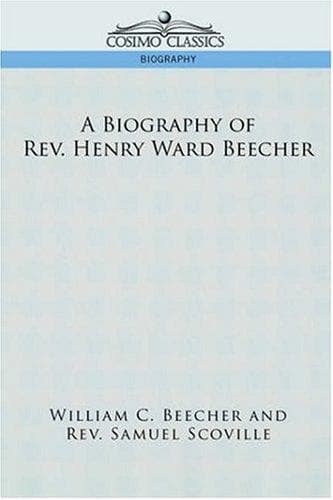
A Biography of Rev. Henry Ward BeecherScoville, Samuel
Religion
A Biography of Rev. Henry Ward Beecher
Scoville, Samuel
Beecher, Henry Ward, 1813-1887
On two leaves of his diary, written probably while at his home in Boston
in the vacation that followed his Freshman year, and during the summer
in which he had made the acquaintance of Miss Bullard, we find the
following:
“_Sept. 3, 1831, Sab. morn._—I found the correspondence of my father and
own mother this morning, and eagerly sought out _her_ letters and read
them. O my mother! I could not help kissing the letters. I looked at the
paper and thought that her hand had rested upon it while writing it. The
hand of my mother! She had formed every letter which I saw. _She_ had
_looked_ upon that paper which I now looked upon. She had folded it. She
had sent it. But I found out more of her _mind_ than I ever knew before;
more of her _feelings_, her _piety_. I should think from her writings
that she was very _amiable_, _lovely_, and _confiding_ in her
disposition, yet had much dignity. She appeared to have a mind very
clear, strong, yet not _perceptible_ till brought out by her feelings.
Her letter to father in which she treats of ‘love to _God_, whether we
should love him because he has done us good or not,’ etc., I was much
pleased with. And I could not help observing that her letters were
superior, more refined and conclusive, than the corresponding ones of
father’s. They corresponded upon _subjects_, it seems, as pride, dress,
slander, etc., etc. Her piety was doubted by herself, although no one
who reads her description of her feelings can doubt for a moment that
Christ was found within her heart.
“The letter to father in reply, apparently, to one in which he had
expressed his feelings toward her and urged for her permission to hope
for a future union, pleased me much. There was much playfulness about
it. I thought that I could see that she loved him while she was writing
it, yet she tried not exactly to show it. I should think that at the
conclusion she told her feelings frankly, from one line which I saw, but
the rest was torn off. I suspect that father did it that no one might
ever see it.”
In common with many other students of limited means, he taught a term of
eight weeks during three of the four years of his college course, using
the winter vacation, which was at first six weeks long, and borrowing
two weeks from the winter term in college.
Of his experience in Hopkinton and some other matters, especially the
fear of his friends concerning his engagement, the following letter to
his brother William gives some interesting details:
“HOPKINTON, Friday eve, 1832.
”MY DEAR BROTHER:
Public-domain text, read in full here on John Shaqi.
Reviews
Reviews
No reviews yet
Be the first to share your thoughts on this work.
Elsewhere in the archive
Join the Discussion
Join the discussion
Sign in to leave a comment or review.
Sign InorCreate an account