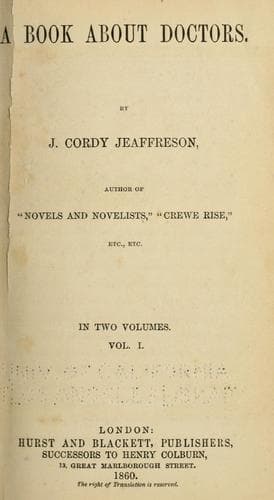
Medicine -- Anecdotes; Physicians -- Great Britain
A sincerely religious man, Blackmore was offended with the gross
licentiousness of the drama, and all those productions of the poets
which constituted the light literature of the eighteenth century. To
his eternal honour, Blackmore was the first man who had the courage to
raise his voice against the evil, and give utterance to a manly
indignation at the insults offered nightly in every theatre to public
decency. Unskilled in the use of the pen, of an age when he could not
hope to perfect himself in an art to which he had not in youth
systematically trained himself, and immersed in the cares of an
extensive practice, he set himself to work on the production of a
poem, which should elevate and instruct, not vitiate and deprave
youthful readers. In this spirit "Prince Arthur" was composed and
published in 1695, when the author was between forty and fifty years
of age. It was written, as he frankly acknowledged, "by such catches
and starts, and in such occasional uncertain hours as his profession
afforded, and for the greatest part in coffee-houses, or in passing up
and down streets." The wits laughed at him for writing "to the
rumbling of his chariot-wheels," but at this date, ridicule thrown on
a man for doing good at odd scraps of a busy day, has a close
similarity to the laughter of fools. Let any reader compare the
healthy gentlemanlike tone of the preface to "Prince Arthur," with the
mean animosity of all the virulent criticisms and sarcasms that were
directed against the author and his works, and then decide on which
side truth and good taste lie.
Blackmore made the fatal error of writing too much. His long poems
wearied the patience of those who sympathized with his goodness of
intention. What a list there is of them, in Swift's inscription, "to
be put under Sir Richard's picture!"
"See, who ne'er was, or will be half read,
Who first sung Arthur, then sung Alfred,[7]
Praised great Eliza[8] in God's anger,
Till all true Englishmen cried, hang her!
. . . . .
Then hiss'd from earth, grown heavenly quite,
Made every reader curse the light.[9]
Mauled human wit in one thick satire;[10]
Next, in three books, spoil'd human nature;[11]
Ended Creation[12] at a jerk,
And of Redemption[13] made damn'd work:
Then took his muse at once, and dipp'd her
Full in the middle of the Scripture.
What wonders there the man grown old did!
Sternhold himself he out-sternholded;
Made David[14] seem so mad and freakish,
All thought him just what thought king Achish.
No mortal read his Solomon,[15]
But judged R'oboam his own son.
Moses[16] he served, as Moses Pharaoh,
And Deborah as she Sisera:
Made Jeremy[17] full sore to cry,
And Job[18] himself curse God and die."
[7] Two heroic Poems, folio, twenty books.
[8] An heroic Poem, in twelve books.
[9] Hymn to Light.
[10] Satire against Wit.
[11] Of the Nature of Man.
Public-domain text, read in full here on John Shaqi.
Reviews
Reviews
No reviews yet
Be the first to share your thoughts on this work.
Elsewhere in the archive
Join the Discussion
Join the discussion
Sign in to leave a comment or review.
Sign InorCreate an account