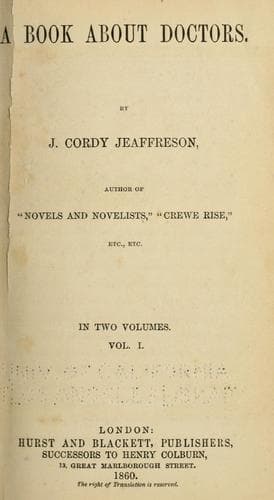
Medicine -- Anecdotes; Physicians -- Great Britain
And after all--the slander and the maledictions--Sir Richard Blackmore
gained the victory, and the wits who never wearied of calling him "a
fool" were defeated. The preface to "Prince Arthur" provoked
discussion; the good sense and better taste of the country were
roused, and took the reformer's side of the controversy. Pope and his
myrmidons, it was true, were still able to make the _beau monde_ merry
about the city knight's presumption--but they could not refute the
city knight's arguments; and they themselves were compelled to shape
their conduct, as writers, in deference to a new public feeling which
he was an important instrument in calling into existence. "Prince
Arthur" appeared in 1695, and to the commotion caused by its preface
may be attributed much of the success of Jeremy Collier's "Short View
of the Immorality and Profaneness of the Stage," which was published
some three years afterwards.
As a poet Sir Richard Blackmore can command only that praise which the
charitable bestow on goodness of intention. His muse was a pleasant,
well-looking, right-minded young lady, but nothing more. But it must
be remembered, before we measure out our criticisms on his
productions, that he never arrogated to himself the highest honours of
poesy. "I am a gentleman of taste and culture, and though I cannot
ever hope to build up the nervous lines of Dryden, or attain the
polish and brilliance of Congreve, I believe I can write what the
generation sorely needs--works that intelligent men may study with
improvement, devout Christians may read without being offended, and
pure-minded girls may peruse without blushing from shame. 'Tis true I
am a hard-worked doctor, spending my days in coffee-houses, receiving
apothecaries, or driving over the stones in my carriage, visiting my
patients. Of course a man so circumstanced must fail to achieve
artistic excellence, but still I'll do my best." Such was the language
with which he introduced himself to the public.
His best poem, _The Creation_, had such merit that his carping
biographer, Johnson, says, "This poem, if he had written nothing else,
would have transmitted him to posterity one of the first favourites of
the English muse"; and Addison designated the same poem "one of the
most useful and noble productions in our English verse."
Of Sir Richard's private character Johnson remarks--"In some part of
his life, it is not known when, his indigence compelled him to teach a
school--a humiliation with which, though it certainly lasted but a
little while, his enemies did not forget to reproach him when he
became conspicuous enough to excite malevolence; and let it be
remembered, for his honour, that to have been a schoolmaster is the
only reproach which all the perspicacity of malice, animated by wit,
has ever fixed upon his private life."
CHAPTER XI.
THE GENEROSITY AND THE PARSIMONY OF PHYSICIANS.
Public-domain text, read in full here on John Shaqi.
Reviews
Reviews
No reviews yet
Be the first to share your thoughts on this work.
Elsewhere in the archive
Join the Discussion
Join the discussion
Sign in to leave a comment or review.
Sign InorCreate an account