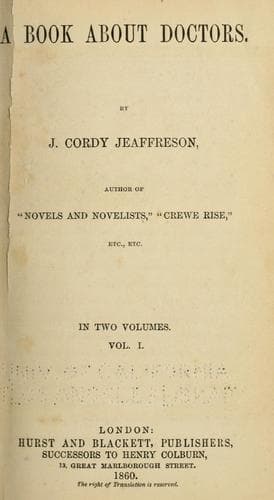
Medicine -- Anecdotes; Physicians -- Great Britain
"Here, my good woman," said Monsey, "out with your apron, and put the
beef into it, and make haste home to your family."
Blessing the benevolent heart of the eccentric old gentleman, the
woman did as she was bid, took possession of her meat, and was
speedily out of sight.
"And there, my man," said Monsey, turning to the butcher, "is tenpence
halfpenny, the price of your beef."
"What do you mean?" demanded the man.
"Simply that that's all I'll pay you. You said the meat was a penny a
pound. At that price I bought it of you--to give to the poor woman.
Good morning!"
A fee that Dr. Fothergill took of Mr. Grenville was earned without
much trouble. Fothergill, like Lettsom, was a Quaker, and was warmly
supported by his brother sectarians. In the same way Mead was brought
into practice by the Nonconformists, to whom his father ministered
spiritually. Indeed, Mead's satirists affirmed that when his servant
(acting on instructions) had called him out from divine service, the
parson took his part in the "dodge" by asking the congregation to
pray for the bodily and ghostly welfare of the patient to whom his son
had just been summoned. Dissenters are remarkable for giving staunch
support, and thorough confidence, to a doctor of their own persuasion.
At the outbreak of the American war, therefore Grenville knew that he
could not consult a better authority than the Quaker doctor,
Fothergill, on the state of feeling amongst the Quaker colonists.
Fothergill was consequently summoned to prescribe for the politician.
The visit took the form of an animated discussion on American affairs,
which was brought to a conclusion by Grenville's putting five guineas
into the physician's hand, saying--"Really, doctor, I am so much
better, that I don't want you to prescribe for me." With a canny
significant smile Fothergill, keeping, like a true Quaker, firm hold
of the money, answered, "At this rate, friend, I will spare thee an
hour now and then."
Dr. Glynn, of Cambridge, was as benevolent as he was eccentric. His
reputation in the fen districts as an ague doctor was great, and for
some years he made a large professional income. On one occasion a poor
peasant woman, the widowed mother of an only son, trudged from the
heart of the fens into Cambridge, to consult the doctor about her boy,
who was ill of an ague. Her manner so interested the physician, that
though it was during an inclement winter, and the roads were almost
impassable to carriages, he ordered horses, and went out to see the
sick lad. After a tedious attendance, and the exhibition of much port
wine and bark (bought at the doctor's expense), the patient recovered,
and Glynn took his leave. A few days after the farewell visit, the
poor woman again presented herself in the consulting room.
"I hope, my good woman," said Glynn, "your son is not ill again?"
Public-domain text, read in full here on John Shaqi.
Reviews
Reviews
No reviews yet
Be the first to share your thoughts on this work.
Elsewhere in the archive
Join the Discussion
Join the discussion
Sign in to leave a comment or review.
Sign InorCreate an account