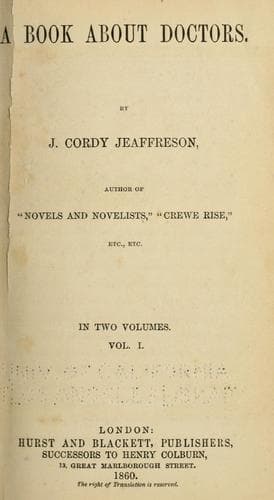
Medicine -- Anecdotes; Physicians -- Great Britain
Abernethy was very careful not to take fees from patients if he
suspected them to be in indigent circumstances. Mr. George Macilwain,
in his instructive and agreeable "Memoirs of John Abernethy," mentions
a case where an old officer of parsimonious habits, but not of
impoverished condition, could not induce Abernethy to accept his fee,
and consequently forbore from again consulting him. On another
occasion, when a half-pay lieutenant wished to pay him for a long and
laborious attendance, Abernethy replied, "Wait till you're a general;
then come and see me, and we'll talk about fees." To a gentleman of
small means who consulted him, after having in vain had recourse to
other surgeons, he said--"Your recovery will be slow. If you don't
feel much pain, depend upon it you are gradually getting round; if you
do feel much pain, then come again, _but not else_. I don't want your
money." To a hospital student (of great promise and industry, but in
narrow circumstances), who became his dresser, he returned the
customary fee of sixty guineas, and requested him to expend them in
the purchase of books and securing other means of improvement. To a
poor widow lady (who consulted him about her child), he, on saying
good-bye in a friendly letter, returned all the fees he had taken from
her under the impression that she was in good circumstances, and added
£50 to the sum, begging her to expend it in giving her child a daily
ride in the fresh air. He was often brusque and harsh, and more than
once was properly reproved for his hastiness and want of
consideration.
"I have heard of your rudeness before I came, sir," one lady said,
taking his prescription, "but I was not prepared for such treatment.
What am I to do with this?"
"Anything you like," the surgeon roughly answered. "Put it on the fire
if you please."
Taking him at his word, the lady put her fee on the table, and the
prescription on the fire; and making a bow, left the room. Abernethy
followed her into the hall, apologizing, and begging her to take back
the fee or let him write another prescription; but the lady would not
yield her vantage-ground.
Of operations Abernethy had a most un-surgeon-like horror--"like
Cheselden and Hunter, regarding them as the reproach of the
profession." "I hope, sir, it will not be long," said a poor woman,
suffering under the knife. "No, indeed," earnestly answered Abernethy,
"that would be too horrible." This humanity, on a point on which
surgeons are popularly regarded as being devoid of feeling, is very
general in the profession. William Cooper (Sir Astley's uncle) was,
like Abernethy, a most tender-hearted man. He was about to amputate a
man's leg, in the hospital theatre, when the poor fellow, terrified at
the display of instruments and apparatus, suddenly jumped off the
table, and hobbled away. The students burst out laughing; and the
surgeon, much pleased at being excused from the performance of a
painful duty, exclaimed, "By God, I am glad he's gone!"
Public-domain text, read in full here on John Shaqi.
Reviews
Reviews
No reviews yet
Be the first to share your thoughts on this work.
Elsewhere in the archive
Join the Discussion
Join the discussion
Sign in to leave a comment or review.
Sign InorCreate an account