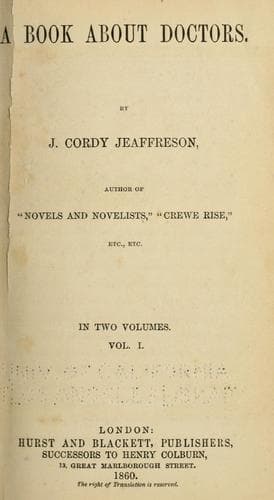
Medicine -- Anecdotes; Physicians -- Great Britain
"Besides the former rules for such as pleases
Of letting bloud to take more observation;
. . . . .
To old, to young, both letting blood displeases.
By yeares and sickness make your computation.
First in the spring for quantity you shall
Of bloud take twice as much as in the fall;
In spring and summer let the right arme bloud,
The fall and winter for the left are good."
Wadd mentions an old surgical writer who divides his chapter on
bleeding under such heads as the following:--1. What is to limit
bleeding? 2. Qualities of an able phlebotomist; 3. Of the choice of
instruments; 4. Of the band and bolster; 5. Of porringers; 6.
_Circumstances to be considered at the bleeding of a Prince._
Simon Harward's "Phlebotomy, or Treatise of Letting of Bloud; fitly
serving, as well for an advertisement and remembrance to all
well-minded chirurgians, as well also to give a caveat generally to
all men to beware of the manifold dangers which may ensue upon rash
and unadvised letting of bloud," published in the year 1601, contains
much interesting matter on the subject of which it treats. But a yet
more amusing work is one that Nicholas Gyer wrote and published in
1592, under the following title:--
"The English Phlebotomy; or, Method and Way of Healing by Letting of
Bloud."
On the title-page is a motto taken from the book of Proverbs--"The
horse-leach hath two daughters, which crye, 'give, give.'"
[Illustration: _THE FOUNDERS OF THE MEDICAL SOCIETY OF LONDON_]
The work affords some valuable insight into the social status of the
profession in the sixteenth century.
In his dedicatory letter to Master Reginald Scot, Esquire, the author
says that phlebotomy "is greatly abused by vagabund horse-leaches
and travailing tinkers, who find work almost in every village through
whom it comes (having in truth neither knowledge, nor witte, nor
honesty), the sober practitioner and cunning chirurgian liveth basely,
is despised, and accounted a very abject amongst the vulgar sort." Of
the medical skill of Sir Thomas Eliot, and Drs. Bulleyn, Turner,
Penié, and Coldwel, the author speaks in terms of warm eulogy; but as
for the tinkers aforementioned, he would regard them as murderers, and
"truss them up at Tyborne."
Gyer, who indulges in continual reference to the "Schola Salerni,"
makes the following contribution to the printed metrical literature on
Venesection:--
"_Certaine very old English verses, concerning the veines
and letting of bloud, taken out of a very auncient paper
book of Phisicke notes_:--
Public-domain text, read in full here on John Shaqi.
Reviews
Reviews
No reviews yet
Be the first to share your thoughts on this work.
Elsewhere in the archive
Join the Discussion
Join the discussion
Sign in to leave a comment or review.
Sign InorCreate an account