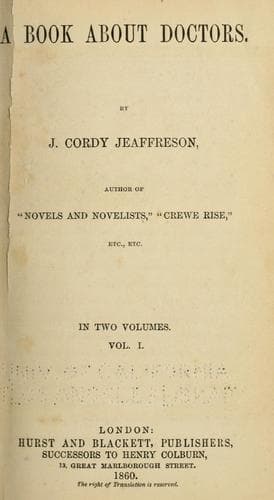
Medicine -- Anecdotes; Physicians -- Great Britain
So that our Lord be them helping,
That all hath in his governing.
So mote it be, so say all wee,
Amen, amen, for charitee."
To bleed on May-day is still the custom with ignorant people in a few
remote districts. The system of vernal minutions probably arose from
that tendency in most men to repeat an act (simply because they have
done it once) until it has become a habit, and then superstitiously to
persevere in the habit, simply because it is a habit. How many aged
people read certain antiquated journals, as they wear exploded
garments, for no other reason than that they read the same sort of
literature, and wore the same sort of habiliments, when young. To miss
for once the performance of a periodically recurring duty, and so to
break a series of achievements, would worry many persons, as the
intermitted post caused Dr. Johnson discomfort till he had returned
and touched it. As early as the sixteenth century, we have Gyer
combating the folly of people having recourse to periodic
venesections. "There cometh to my minde," he says, "a common opinion
among the ignorant people, which do certainly beleeve that, if any
person be let bloud one yere, he must be let bloud every yere, or else
he is (I cannot tell, nor they neither) in how great danger. Which
fonde opinion of theirs, whereof soever the same sprong first, it is
no more like to be true, than if I should say: when a man hath
received a great wound by chaunce in any part of his body, whereby he
loseth much bloud; yet after it is healed, he must needs have the like
wounde againe there the next yeare, to avoid as much bloud, or els he
is in daunger of great sickness, yea, and also in hazard to lose his
life."
The practitioners of phlebotomy, and the fees paid for the operation,
have differed widely. In the middle of the last century a woman used
the lancet with great benefit to her own pocket, if not to her
patients, in Marshland, in the county of Norfolk. What her charge was
is unknown, probably, however, only a few pence. A distinguished
personage of the same period (Lord Radnor) had a great fondness for
letting the blood (at the point of an amicable lancet--not a hostile
sword) of his friends. But his Lordship, far from accepting a fee, was
willing to remunerate those who had the courage to submit to his
surgical care. Lord Chesterfield, wanting an additional vote for a
coming division in the House of Peers, called on Lord Radnor, and,
after a little introductory conversation, complained of a distressing
headache.
"You ought to lose blood then," said Lord Radnor.
"Gad--do you indeed think so? Then, my dear lord, do add to the
service of your advice by performing the operation. I know you are a
most skilful surgeon."
Delighted at the compliment, Lord Radnor in a trice pulled out his
lancet-case, and opened a vein in his friend's arm.
"By-the-by," asked the patient, as his arm was being adroitly bound
up, "do you go down to the House to-day?"
Public-domain text, read in full here on John Shaqi.
Reviews
Reviews
No reviews yet
Be the first to share your thoughts on this work.
Elsewhere in the archive
Join the Discussion
Join the discussion
Sign in to leave a comment or review.
Sign InorCreate an account