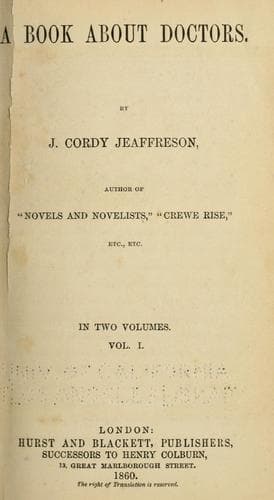
Medicine -- Anecdotes; Physicians -- Great Britain
But in the last century the beneficed clergy were in a very different
pecuniary condition from that which they at present enjoy. Till the
Tithe Communication Act passed, the parson (unless he was a sharp man
of business, shrewd and unscrupulous as a horse-jobber, and ready to
have an unintermittent war with his parishioners) never received
anything like what he was entitled to of the produce of the land.
Often he did not get half his dues; and even when he did obtain a fair
tithe, his receipts were small compared with what his successor in the
present generation has from the same source. Agriculture was then in
such a backward state, and land was so ill-cultivated, that the rector
of a large parish of good land was justly entitled only to a sum that
a modern rent-charge holder would regard with painful surprise if told
that he might take nothing more for his share in the fruits of the
earth. The beneficed clergy were a comparatively poor body. The curate
perhaps was not in a worse state than he is in now, for the simple
reason that a worse can hardly be. To add to the impoverished
appearance of the clerical profession, there existed in every capital
and country town the luckless nonconforming clergy, bereft of the
emoluments of their vocation, and often reduced to a condition
scarcely--if at all--removed from begging. The title of _Reverend_ was
still affixed to their names--their costume was still that of their
order--and by large masses of the people they were regarded with more
reverence and affection than the well-fed Vicars of Bray, who, with
mealy mouths and elastic consciences, saw only the butter on one side
of their bread, and not the dirt on the other. Archbishop Sancroft
died on his little farm in Suffolk, having for years subsisted on
about fifty pounds a-year. When such was the fate of an Archbishop of
Canterbury, the straits to which the ejected vicars or disabled
curates were brought can be imagined--but scarcely described. In the
great towns these unfortunate gentlemen swarmed, gaining a wretched
subsistence as ushers in schools, tutors, secretaries--not
unfrequently as domestic servants.
In such a condition of the established church, the rule of never
taking money from "the cloth" was almost invariably observed by the
members of the medical profession.
Mead once--and only once--departed from this rule. Mr. Robert Leake, a
fellow of St. John's College, Cambridge, called on the doctor and
sought his advice. The patient's ill-health had been in a great degree
effected by doctoring himself--that is, exhibiting, according to his
own notions of medical practice, some of Dr. Cheyne's prescriptions.
"Do as I tell you," said Mead, "and I'll set you up again."
Public-domain text, read in full here on John Shaqi.
Reviews
Reviews
No reviews yet
Be the first to share your thoughts on this work.
Elsewhere in the archive
Join the Discussion
Join the discussion
Sign in to leave a comment or review.
Sign InorCreate an account