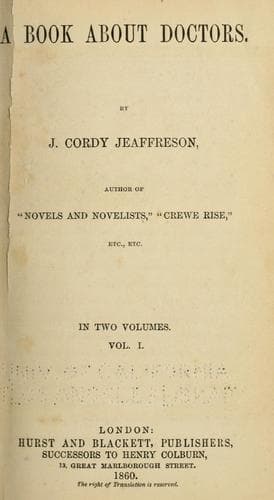
Medicine -- Anecdotes; Physicians -- Great Britain
To the last Monsey acted by his own rules instead of by those of other
people. He lived to extreme old age, dying in his rooms in Chelsea
College, on December 26th, 1788, in his ninety-fifth year; and his
will was as remarkable as any other feature of his career. To a young
lady mentioned in it, with the most lavish encomiums on her wit,
taste, and elegance, was left an old battered snuff-box--not worth
sixpence; and to another young lady, whom the testator says he
intended to have enriched with a handsome legacy, he leaves the
gratifying assurance that he changed his mind on finding her "a pert,
conceited minx." After inveighing against bishops, deans, and
chapters, he left an annuity to two clergymen who had resigned their
preferment on account of the Athanasian doctrine. He directed that his
body should not be insulted with any funeral ceremony, but should
undergo dissection; after which, the "remainder of my carcase" (to use
his own words) "may be put into a hole, or crammed into a box with
holes, and thrown into the Thames." In obedience to this part of the
will, Mr. Forster, surgeon, of Union Court, Broad Street, dissected
the body, and delivered a lecture on it to the medical students in the
theatre of Guy's Hospital. The bulk of the doctor's fortune, amounting
to about £16,000, was left to his only daughter for life, and after
her demise, by a complicated entail, to her _female_ descendants. This
only child, Charlotte Monsey, married William Alexander, a
linen-draper in Cateaton Street, City, and had a numerous family. One
of her daughters married the Rev. Edmund Rolfe, rector of Cockley
Clay, Norfolk, of which union Robert Monsey Rolfe, Baron Cranworth of
Cranworth, county of Norfolk, is the offspring.
Before making the above-named and final disposition of his body, the
old man found vent for his ferocious cynicism and vulgar infidelity in
the following epitaph, which is scarcely less characteristic of the
society in which the writer had lived, than it is of the writer
himself:--
"MOUNSEY'S EPITAPH, WRITTEN BY HIMSELF."
"Here lie my old bones; my vexation now ends;
I have lived much too long for myself and my friends.
As to churches and churchyards, which men may call holy,
'Tis a rank piece of priestcraft, and founded on folly.
What the next world may be never troubled my pate;
And be what it may, I beseech you, O fate,
When the bodies of millions rise up in a riot,
To let the old carcase of Mounsey be quiet."
Public-domain text, read in full here on John Shaqi.
Reviews
Reviews
No reviews yet
Be the first to share your thoughts on this work.
Elsewhere in the archive
Join the Discussion
Join the discussion
Sign in to leave a comment or review.
Sign InorCreate an account