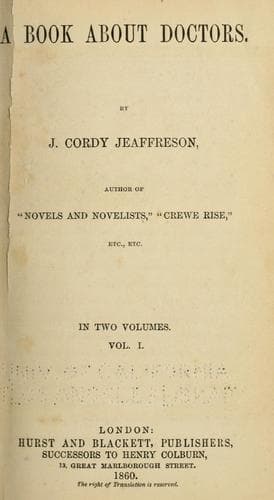
Medicine -- Anecdotes; Physicians -- Great Britain
Akenside's self-love received a more humorous stab than the poke
administered by Richard Chester's blunt cudgel, from Mr. Baker, one of
the surgeons at St. Thomas's. To appreciate the full force of the
story, the reader must recollect that the jealousy, which still exists
between the two branches of the medical profession, was a century
since so violent that even considerations of interest failed in some
cases to induce eminent surgeons and physicians to act together. One
of Baker's sons was the victim of epilepsy, and frequent fits had
impaired his faculties. Baker was naturally acutely sensitive of his
child's misfortune, and when Akenside had the bad taste to ask to what
study the afflicted lad intended to apply, the father answered, "I
find he is not capable of making a surgeon, so I have sent him to
Edinburgh to make a physician of him." Akenside felt this sarcasm so
much, that he for a long time afterward refused to hold any
intercourse with Baker.
But Akenside had many excuses for his irritability. He was very
ambitious, and failed to achieve that success which the possession of
great powers warranted him in regarding as his due. It was said of
Garth that no physician understood his art more, or his trade less!
and this, as Mr. Bucke, in his beautiful "Life of Arkenside," remarks,
was equally true of the doctor of St. Thomas's. He had a thirst for
human praise and worldly success, and a temperament that caused him,
notwithstanding all his sarcasms against love, to estimate at their
full worth the joys of married life; yet he lived all his days a poor
man, and died a bachelor. Other griefs also contributed to sour his
temper. His lot was cast in times that could not justly appreciate his
literary excellences. His sincere admiration of classic literature and
art and manners was regarded by the coarse herd of rich and stupid
Londoners as so perfectly ridiculous, that when Smollett had the bad
taste to introduce him into _Peregrine Pickle_, as the physician who
gives a dinner after the manner of the ancients, the applause was
general, and every city tradesman, with scholarship enough to read the
novel, had a laugh at the expense of a man who has some claims to be
regarded as the greatest literary genius of his time. The polished and
refined circles of English life paid homage to his genius, but even in
them he failed to meet with the cordial recognition he deserved.
Johnson, though he placed him above Gray and Mason, did not do him
justice. Boswell didn't see much in him. Horace Walpole differed from
the friend who asked him to admire the "Pleasures of Imagination."
The poets and wits of his own time had a high respect for his critical
opinion, and admitted the excellence of his poetry--but almost
invariably with some qualification. And Akenside was one who thirsted
for the complete assent of the applauding world. He died after a brief
illness in his forty-ninth year, on the 23rd of June, 1770; and we
Public-domain text, read in full here on John Shaqi.
Reviews
Reviews
No reviews yet
Be the first to share your thoughts on this work.
Elsewhere in the archive
Join the Discussion
Join the discussion
Sign in to leave a comment or review.
Sign InorCreate an account