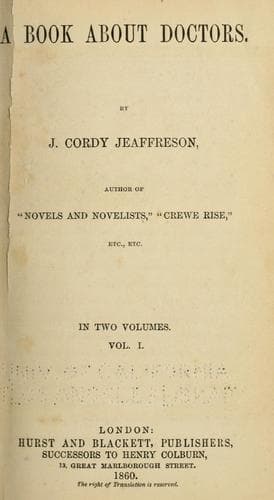
Medicine -- Anecdotes; Physicians -- Great Britain
For many a day authors have had the reputation of being more sensitive
and quarrelsome than any other set of men. Truth to tell, they are not
always so amiable and brilliant as their works. There is in them the
national churlishness inducing them to nurse a contempt for every one
they don't personally know, and a spirit of antagonism towards nearly
every one they do. But to say this is only to say that they are made
of British oak. Unfortunately, however, they carry on their
contentions in a manner that gives them a wide publicity and a
troublesome duration of fame. Soldiers, when they quarrelled in the
last century, shot one another like gentlemen, at two paces' distance,
and with the crack of their pistols the whole noise of the matter
ceased. Authors, from time immemorial, have in their angry moments
rushed into print, and lashed their adversaries with satire, rendered
permanent by aid of the printer's devil,--thus letting posterity know
all the secrets of their folly, whilst the merciful grave put an end
to all memorial of the extravagances of their friends. There was
less love between Radcliffe and Hannes, Freind and Blackmore, Gibbons
and Garth, than between Pope and Dennis, Swift and Grub Street. But we
know all about the squabbles of the writers from their poems; whereas
only a vague tradition, in the form of questionable anecdotes, has
come down to us of the animosities of the doctors--a tradition which
would long ere this have died out, had not Garth--author as well as
physician--written the "Dispensary," and a host of dirty little
apothecaries contracted a habit of scribbling lampoons about their
professional superiors.
Luckily for the members of it, the Faculty of Medicine is singularly
barren of biographies. The career of a physician is so essentially one
of confidence, that even were he to keep a memorial of its interesting
occurrences, his son wouldn't dare to sell it to a publisher as the
"Revelations of a Departed Physician." Long ere it would be decent or
safe to print such a diary, the public would have ceased to take an
interest in the writer. Pettigrew's "Life of Lettsom," and Macilwain's
"Memoirs of Abernethy," are almost the only two passable biographies
of eminent medical practitioners in the English language; and the last
of these does not presume to enter fully on the social relations of
the great surgeon. The lives of Hunter and Jenner are meagre and
unworthily executed, and of Bransby Cooper's Life of his uncle little
can be said that is not in the language of emphatic condemnation.
From this absence of biographical literature the medical profession at
least derives this advantage--the world at large knows comparatively
little of their petty feuds and internal differences than it would
otherwise.
Public-domain text, read in full here on John Shaqi.
Reviews
Reviews
No reviews yet
Be the first to share your thoughts on this work.
Elsewhere in the archive
Join the Discussion
Join the discussion
Sign in to leave a comment or review.
Sign InorCreate an account