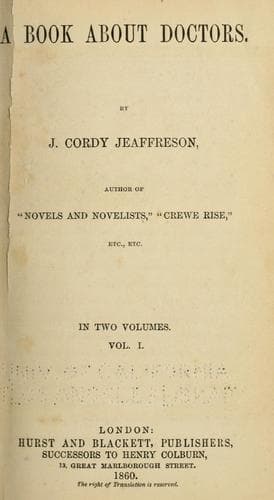
Medicine -- Anecdotes; Physicians -- Great Britain
"With him was sometimes joined in silken walk
(Profoundly silent--for they never spoke),
One shyer still, who quite detested talk;
If stung by spleen, at once away he broke
To grove of pine and broad o'ershadowing oak.
There, inly thrilled, he wandered all alone,
And on himself his pensive fury woke:
He never uttered word, save when first shone
The glittering star of eve--'Thank Heaven, the day is done.'"
His medical writings, and his best known poem, "The Art of Health,"
had he written nothing else, would in all probability have brought him
patients, but the licentiousness of "The Economy of Love" effectually
precluded him from ever succeeding as a family physician. Amongst
Armstrong's poet friends was Grainger, the amiable and scholarly
physician who enjoyed the esteem of Percy and Samuel Johnson,
Shenstone and Sir Joshua. Soon after the publication of his
translation of the "Elegies of Tibullus," (1758), Grainger went to the
island of St. Christopher's, and established himself there as a
physician. The scenery and industrial occupations of the island
inspired him to write his most important poem, "The Sugar-Cane,"
which, in escaping such derision as was poured on Blackmore's
effusions, owed its good fortune to the personal popularity of the
author rather than its intrinsic merits. The following sample is a
fair one:--
"Destructive on the upland groves
The monkey nation preys: from rocky heights,
In silent parties they descend by night,
And posting watchful sentinels, to warn
When hostile steps approach, with gambols they
Pour o'er the cane-grove. Luckless he to whom
That land pertains! in evil hour, perhaps,
And thoughtless of to-morrow, on a die
He hazards millions; or, perhaps, reclines
On luxury's soft lap, the pest of wealth;
And, inconsiderate, deems his Indian crops
Will amply her insatiate wants supply.
"From these insidious droles (peculiar pest
Of Liamigia's hills) would'st thou defen
Thy waving wealth, in traps put not thy trust,
However baited: treble every watch,
And well with arms provide them; faithful dogs,
Of nose sagacious, on their footsteps wait.
With these attack the predatory bands;
Quickly, th' unequal conflict they decline,
And chattering, fling their ill-got spoils away.
So when, of late, innumerous Gallic hosts,
Fierce, wanton, cruel, did by stealth invade
The peaceable American's domains,
While desolation mark'd their faithless rout;
No sooner Albion's martial sons advanc'd,
Than the gay dastards to their forests fled,
And left their spoils and tomahawks behind.
"_Nor with less haste the whisker'd vermin race,
A countless clan, despoil the low-land cane._
"These to destroy, &c."
When the poem was read in MS. at Sir Joshua's house, the lines printed
in italics were not part of the production, but in their place stood--
Public-domain text, read in full here on John Shaqi.
Reviews
Reviews
No reviews yet
Be the first to share your thoughts on this work.
Elsewhere in the archive
Join the Discussion
Join the discussion
Sign in to leave a comment or review.
Sign InorCreate an account