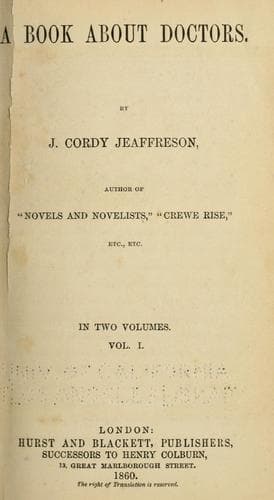
Medicine -- Anecdotes; Physicians -- Great Britain
It was during his apprenticeship to Mr. Page of Woodbridge that Crabbe
made his first important efforts in poetry, publishing, in the year
1772, some fugitive pieces in _Wheble's Magazine_, and in 1775
"Inebriety, a poem, in three parts. Ipswich: printed and sold by C.
Punchard, bookseller, in the Butter-market." While at Woodbridge, too,
his friend Levett, a young surgeon of the neighborhood, took him over
to Framlingham, introducing him to the families of that picturesque
old town. William Springall Levett was at that time engaged to Alethea
Brereton, a lady who, under the _nom de plume_ of "Eugenia Acton,"
wrote certain novels that created a sensation in their brief day.
Amongst them were "Vicissitudes of Genteel Life," "The Microcosm,"
and "A Tale without a Title." The love-making of Mr. Levett and Miss
Eugenia de Acton was put a stop to by the death of the former, in
1774. The following epitaph, transcribed from the History of
Framlingham, the work of the able antiquarian, Mr. Richard Green, is
interesting as one of Crabbe's earlier compositions.
"What! though no trophies peer above his dust,
Nor sculptured conquests deck his sober bust;
What! though no earthly thunders sound his name,
Death gives him conquest, and our sorrows fame!
One sigh reflection heaves, but shuns excess,
More should we mourn him, did we love him less."
Subsequently Miss Brereton married a gentleman named Lewis, engaged in
extensive agricultural operations. However brief her literary
reputation may have been, her pen did her good service; for, at a
critical period of her husband's career, it brought her sums of
much-needed money.
Mr. Levett's romance closed prematurely together with his life, but
through him Crabbe first became acquainted with the lovely girl whom
he loved through years of trial, and eventually made his wife. Sarah
Elmy was the niece of John Tovell, _yeoman_, not _gentleman_--he would
have scorned the title. Not that the worthy man was without pride of
divers kinds, or that he did not hold himself to be a gentleman. He
believed in the Tovells as being one of the most distinguished
families of the country. A Tovell, by mere right of being a Tovell,
could thrash more Frenchmen than any Englishman, not a Tovell, could.
When the good man said, "I am nothing more than a plain yeoman," he
never intended or expected any one to believe him, or to regard his
words in any other light than as a playful protest against being
deemed "a plain yeoman," or that modern hybrid, "a gentleman farmer."
He was a well-made, handsome, pleasant fellow--riding a good horse
with the hounds--loving good cheer--enjoying laughter, without being
very particular as to the cause of it--a little too much addicted to
carousing, but withal an agreeable and useful citizen; and he lived at
Parham Lodge, a house that a peer inhabited after him, without making
any important alterations in the place.
Public-domain text, read in full here on John Shaqi.
Reviews
Reviews
No reviews yet
Be the first to share your thoughts on this work.
Elsewhere in the archive
Join the Discussion
Join the discussion
Sign in to leave a comment or review.
Sign InorCreate an account