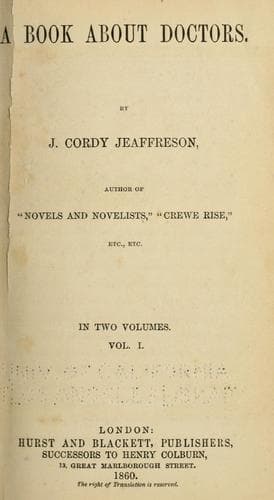
Medicine -- Anecdotes; Physicians -- Great Britain
The medical buildings of London are seldom or never visited by the
sight-seers of the metropolis. Though the science and art of nursing
have recently been made sources of amusement to the patrons of
circulating libraries, the good sense and delicacy of the age are
against converting the wards of an hospital into galleries for public
amusement. In the last century the reverse was the case. Fashionable
idlers were not indeed anxious to pry into the mysteries of
Bartholomew's, Guy's, and St. Thomas's hospitals; for a visit to those
magnificent institutions was associated in their minds with a risk of
catching fevers or the disfiguring small-pox. But Bethlehem, devoted
to the entertainment and cure of the insane, was a favourite haunt
with all classes. "Pepys," "The London Spy," "The Tatler," and "The
Rake's Progress," give us vivid pictures of a noisy rout of Pall Mall
beaus and belles, country fly-catchers, and London scamps, passing up
and down the corridors of the great asylum, mocking its unhappy
inmates with brutal jests, or investigating and gossiping about their
delusions and extravagances with unfeeling curiosity. Samuel Johnson
enlivened himself with an occasional stroll amongst the lunatics, just
as he periodically indulged himself with witnessing a hanging, a
judicial flogging, or any other of the pleasant spectacles with which
Hogarth's London abounded. Boswell and he once strolled through the
mansions of the insane; and on another occasion, when he visited the
same abode with Murphy, Foote, and Wedderburne (afterwards Lord
Loughborough), the philosopher's "attention was arrested by a man who
was very furious, and who, while beating his straw, supposed it was
William, Duke of Cumberland, whom he was punishing for his cruelties
in Scotland in 1746." Steele, when he took three schoolboys (imagine
the glee of Sir Richard's schoolboy friends out with him for a frolic)
in a hackney coach to show them the town, paid his respects to "the
lions, the tombs, Bedlam, and the other places, which are
entertainments to raw minds because they strike forcibly on the
fancy." In the same way Pepys "stept into Bedlam, and saw several poor
miserable creatures in chains, one of whom was _mad with making
verses_," a form of mental aberration not uncommon in these days,
though we do not deem it necessary to consign the victims of it to
medical guardianship.
The original Bethlehem hospital was established by Henry VIII., in a
religious house that had been founded in 1246, by Simon Fitz-Mary,
Sheriff of London, as an ecclesiastical body. The house was situated
at Charing-cross, and very soon the king began to find it (when used
for the reception of lunatics) disagreeably near his own residence.
The asylum was therefore removed, at a "cost nigh £17,000," to
Bishopgate Without, where it remained till 1814, and the inmates were
removed to the present noble hospital in St. George's Fields, the
first stone of which was laid April 18th, 1812.
Public-domain text, read in full here on John Shaqi.
Reviews
Reviews
No reviews yet
Be the first to share your thoughts on this work.
Elsewhere in the archive
Join the Discussion
Join the discussion
Sign in to leave a comment or review.
Sign InorCreate an account